A Group of Students of IPB Synthesize Supercapacitors from Fish Tanning Process
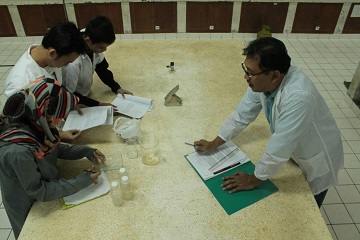
As Shaf Arrad Fitroh of the Faculty of Fisheries and Marine Sciences of Bogor Agricultural University (FPIK-IPB) and his group consists of Akhmad Khoeron, Richo Oscar F, and Yeyen Laorenza, proposed funding support to Program Kreativitas Mahasiswa (PKM–P Student Creativity Program) to make brilliant innovation to synthesize Supercapacitors as energy storage devices. By participating the community service activities in Yogyakarta and Jepara, the young man, whom his friends usually called him Asshaf, got his creative ideas. During the community service activity at the tanneries fish areas, he revealed the untapped waste of these tanneries are spewing toxic waste (poison) and not environmentally friendly.
Fish skin itself is a waste. The various fish tanning process for handicrafts such as wallets and bags, produce of liquid and solids. Similar to most food industries, fish tanning -processing operations produce waste, both in solid (e.g. scales, fins, tails, bones, viscera, skin, heads) as well as liquid (e.g. water discharge from cleaning and rinsing, brine, bloodwater) form. So far, liquid waste is well- managed, while for solid waste so far there is no processing-mill or utilize them for further process. In fact, the chromium content used during the tanning process is still left behind in solid waste and it is very dangerous.
Seeing the phenomenon, this 20-year-old man student took the initiative to find solutions for the utilization of appropriate waste and high value. Asshaf invited his three college friends of IPB to participate in his research program. Analysis of today's most sought-after needs by most people, Asshaf ultimately decided to create a supercapacitor of tannery leather waste materials. In the era of rapid development, almost every day in all sectors relate or depend on electricity and electronics. Rapid progress also leads to a huge need for power or energy, especially electricity. Not just the need for electricity, the need for a large energy storage device is also very necessary. Currently, the available energy storage devices are batteries. However, the battery as an energy storage still has a deficiency of its power storage capacity is still small. Therefore, it is now required a larger energy storage device in the form of supercapacitor, which is made of carbon.
Carbon is chosen because it is relatively low cost, and its development for industrial processes are relatively easy and have a lot of material availability. Activated carbon is generally a material derived from carbon-rich organic precursors such as wood, coal / coke and other organic materials. These materials will be obtained through carbonization or high temperature physical activation and chemical processes. Based on fish waste tannery literature he decided to make active carbon through pyrolysis process at temperature of 600 degree Celcius. Carbon pyrolysis of tannery waste has characteristics of hexagonal structures, arranged in graphite in the presence of one free electron, so it can be conductive so that it is potentially used as an electrical capacitor. (Wied)