
A Group of Students of IPB Established “Program Sekolah Lingkungan”
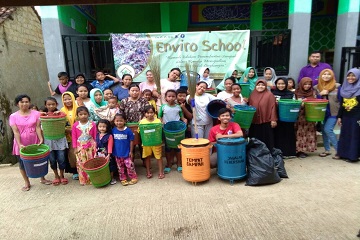
Disposing of waste has huge environmental impacts and can cause serious problems. Environment and Forestry Ministry stated that there were so many problems with regard to waste management in Indonesia that he was mulling whether or not he should declare a state of emergency. Waste issues are common in this country. The waste of both organic and inorganic waste that is thrown away in any place becomes an environmental problem. Indonesia, the world's second biggest contributor to plastic waste in the oceans, is in a state of emergency with regard to waste problems. Its decaying trash disposal sites are struggling to cope with tens of millions of tons of waste every year. The accumulation or disposal of garbage carelessly into open areas, especially rivers, can lead to soil contamination and impact on ground water channels and can also cause disasters.
Lisa Aisa, and her team consists of Sulthon Arif Rakhman, Difa Ashmamillah, Desi Mutiara Fani, and Gilang Aji Pradana, all are student of Bogor Agricultural University (IPB), under the sponsorships of the 2017 Program Kreatifitas Mahasiswa Pengabdian Masyarakat (PKM-M Student Creativity Program for Community Development), implemented their project to observe the garbage condition of Ciaruteun Ilir village, Cibungbulang District, Bogor Regency. It is about 8 km west of IPB Campus, Dramaga, Bogor.
Based on their observation on the condition of garbage in Ciaruteun Ilir Village, the team decided to empower and educate the community, especially the younger generation in the village by providing the training program. The community educational program they planned was on waste management and utilization. They repackaged such educational program into an attractively program they called "Enviro School". It is an educational house for Waste Utilization to cultivate garbage consciousness generation.
"This program started from the restlessness team to see the condition in Ciaruteun Village. The community in such village without any hesitation throw used items and garbage directly into the river, or throw them over this cliff, where underneath it are the agricultural lands of the communities. Of course, there are very harmful effects of throwing garbage anywhere. The situation is due to the unavailability of temporary garbage dumps (TPSS). Residents have proposed to the village head, but so far there is no response, "said Lisa.
"Enviro School" is the community educational program that provides lessons and practical works on waste management and utilization. They are arranged and developed into a "curriculum". The method utilized is “learn, understand, and action”, which means when the participants have undergone into the course, through listening and discussion, they are expected to have behaviour change.
Lessons are presented in the scheduled classes, through lectures and practical works. Classes are conducted utilizing socialization and discussion method, while for practical works by training.
Lecture on waste management is consisted of pre-class materials, the socialization and learning contract, first-class is introduction of household garbage management and the surrounding environment, and game class that is introduction of garbage type through game "pick your garbage".
Practical work on the utilization of garbage which is consisted green-class – the establishment of garbage bank and its management; brown-class – the training program for composting household organic waste; and white-class – the training program for the utilization plastic waste into handicrafts. The white class has produced added-value products to improve their economic status. Finally the team planned “enviroducation fair” to exhibit those added-value products they produced from garbage.
The four-month Community Educational Program, is the partnership program implemented jointly by Gemmar Foundation, Majlis taklim mothers, Bank of Srikandi Berdikari garbage, and Environmental Services of Bogor Regency. The venue of the program will be implemented is Ciaruteun Ilir Village, RT 04/03 and RT 05/03, and has been carried on March -June 2017.
To evaluate the successful implementation of the program, the team have prepared questionnaires to be administered for Enviro School participants, to check whether the course affect the community behaviour changes. At the end the participant of "Enviro School" are expected to be able to manage and utilize waste properly and creatively. (Wied)

