
Tempe of long shelf-life made by IPB Students
Tempe is a popular food among the people of Indonesia. It is rich in protein, and contains vitamin B12 that is rarely found in plant foods. It is a traditional food of soybean fermentation by adding Rhizopus sp. 50% of soybean in Indonesia is used to produce tempe.
One of problems with tempe is the relatively short shelf life of about 1-2 days. The unsold tempe will soon become over fermented and will decompose during storage.
Seeing the problem above, Jeffry Al Bukhori, a student of Bogor Agricultural University (IPB) also Chairman of PKMP (Student Creativity Program of Research) with the team consisting of Novi Kurnianto, Muhammad Afif Shultoni, Muhammad Rizky Marhaban and Fakhri Ramadian Hidayat is doing a study on tempe coating. This study aims to find suitable coating materials for tempe.
As the largest tempe producer in the world, Indonesia should be able to develop its product innovation. One way to extend the shelf life of a food product is by packing. Today edible coating technology is well known. It is a coating technique of a product using a particular material. Edible coatings on food products can inhibit the movement of water vapor, prevent aroma loss and fat transfer, and improve physical characteristics, as well as serve as carriers of additives. The materials used can come from natural ingredients so they are safe to use or consume.
"Because tempe cannot be stored for too long, sellers cannot distribute widely and lose when it decays. Well, we are trying to increase the shelf life of tempe with the coating method commonly used for fresh fruit preservation, but we do not directly apply the coating to the food instead to the packaging used to wrap the tempe product," said Muhammad Afif Sulthoni, a member of the PKMP team.
The innovation of coating tempe uses natural ingredients such as starch, chitosan or onion extract. The team observed the shelf life and physio-chemical characteristics of the tempe treated with coating.
"The ingredient we use for coating is garlic extract, which, based on our study of literature, contains allicin, an antimicrobial substance. The goal is that the decomposing microbes in tempe can be inhibited in number to increase the shelf life of tempe. The treatments include tempe control (without coating), tempe treated with 20% onion coating extract, and tempe with 30% onion coating extract," said Afif.
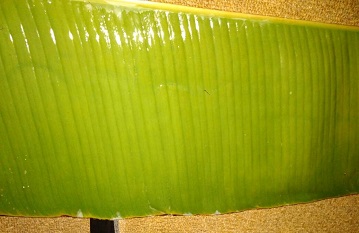
The first thing to do was to make a solution of onion extract by adding ethanol as a solvent. The extract was applied to banana leaves for use as a tempe wrapper. Soybeans already given yeast were wrapped with banana leaves coated with the onion extract (after dry).
"The result was positive. Tempe coated with onion extract had longer shelf-life than the uncoated. On observation, uncoated tempe could last 2-3 days while the coated tempe was still pretty good until day 7. On day 8 its appearance was still good but the smell was rather worse. The data we get shows a garlic concentration of 30% is the best. For a higher concentration, we have not tried it yet. Now we need to test the physio-chemical characteristics of the coated tempe," said Afif. (Mtd)

