
Hayya ‘Alash Sholah, a Five-Times Prayer Education Game Created by IPB Students
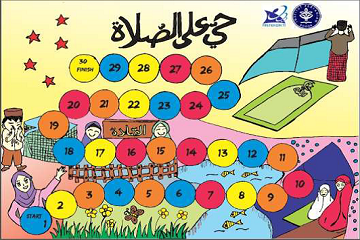
A student of Bogor Agricultural University (IPB), Rafika Zahraini and other fellows in the Student Creativity Program (PKM), namely Uswatun Hasanah, Putri Nur Azizah H, Hanifa Nur Fijrina and Nelly Saidah Amalia creates a game called "Hayya 'Alash Sholah". It is a five-time-a-day prayer education tool. This game involves directly players to take an active role in learning as well as playing. The main target of this learning model is the second grade the elementary pupils of Islamic schools (Madrasah Ibtidaiyah). The reason for Zahraini and the team to choose the second graders is they are around the age of seven, the age recommended by Rasulullah SAW to perform the prayer. It is expected that with the introduction of this educational game, the pupils could understand more about the obligation to pray five times. The game uses the method called SERSAN B3 (Serious and Relaxed in Learning and Playing Together).
The game Hayya 'Alash Sholah is made on a special banner of three by four meters, with the drawing of a circle for a player’s steps numbered from 1 (start) to 30 (finish), with different colors. This game is played by 5 – 6 people with one leader as the game regulator. Players compete against each other to reach the finish on the 30th circle and they will get the top prize.
The game is like a ladder snake but there is a difference in scoring and ending of the game. "The difference with the ladder snakes apart from size is in the winner as well. In the snake ladder, a winner is determined according to who is the fastest to reach the last box, but in this game the player with the most answered questions is the winner, which is indicated by stars. If a participant has reached the finish of the game, the game ends and the game score is calculated based on the stars," said Hanifa, a IPB student from Sukabumi.
Players can move on to the next circle after throwing a dice and being able to answer the challenges (practice, memorization, and questions) on each circle. There are four blocks of challenge cards: the yellow circle is the practice of ablution, the blue circle is a block of religious science, the orange circle is the practice of prayer and prayer recitation, and the pink circle is the bonus block. Players must take a card on each circle and follow the instructions on the card.
Players who face the challenge of practicing or reciting the prayer and ablution should go to the place provided. They will get a reward if they pass every instruction correctly in every circle. Meanwhile, players who cannot get through the challenge will get punishment, e.g. "If a player cannot answer a question, s/he will get a sanction, such as moving back three steps, change questions or demonstrate a talent," said Nely, a team member. Players who manage to answer the questions of all the blocks in the smart card will be given five stars, meaning very good. Answering half of the number of questions correctly will be given three stars (good). Fewer correct answers will get one star, not good. "We hope this game provides education that benefits children and finds new ways to educate children," said Hanifa. (Mtd)

