
Professor of IPB Implemented Three Strategies to Face the Extinction of Non-Timber Forest Resources
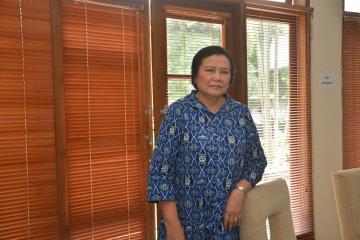
Professor of Faculty of Mathematics and Natural Sciences (FMIPA), Bogor Agricultural University (IPB), Prof.Dr. Suminar Setiati Achmadi, offered three strategies to face the threat of extinction of the resources of Non-Timber Forest Products (HHBK). First, for the policy-makers, it should be re-campaigned the planting of the vegetation of HHBK resources in the forest or non-forest areas. Second, for the chemists, a lot of works of HHBK were such as the isolation techniques and the disclosure of its structure, the proof of efficacy, in order to make derivatives and benefits. Third, the biotechnology should take advantage of other biological species such as the endophytic fungi to provide HHBK.
“Production of HHBK relies on the natural forest resources which extent continues to decline. Policy-setting of the production forest area covering an area of 44 million hectares should also be directed to preserve the production of HHBK. Do not let this tropical typical product exports to be slumped,” she said when delivering the Scientific Oration of the Determination of Professor in Auditorium of Andi Hakim Nasoetion, Campus of IPB Darmaga (23/4).
In her speech entitled “Pelestarian Produk Hasil Hutan Bukan Kayu Berdasarkan Kajian Kimiawi / Preservation of Non-Timber Forest Products Based on the Assessment of Chemicals”, Prof. Suminar explained the study that had been done to HHBK. Among the findings was the proof of gelugur acid as the lowering of the level of Low-density lipoprotein (LDL) and the regulating body weight. Cinnamon oil with the content of trans-sinamaldehid apparently also served as an antioxidant.
Damar of cat eye contained alpha kopaen as the lead compounds. Useful compounds of surian tree (its leaves) containing siklostanol could counteract the free radicals. Gondorukem derivatives of the esters were well-suited for biogasoline.
White belawan species of the peat forest was proved to be used as the medicine for diarrhea. Mace oil from Sulawesi could be synthesized hidroksikavicol which possessed the antibacterial activity, anti-inflammatory, antioxidant, anti cancer and antimutagenic.
Prof. Suminar said, from the study of mycology, there was an amazing example of the quinine tree (malaria drug). Generally, the quinine alkaloid was extracted from the bark of trees. Evidently, the fungus of enofit Cercospora sp and Diaporthe spp isolated from the leaves and the twigs of quinine tree was successfully grown in the synthetic media. Therefore, the quinine could be harvested anytime without relying on the trunk debarking process. There were many more potential of HHBK, but with the depleted forest area, this potential was endangered,” she said. (zul)

