Looking for Sustainable Rural-Urban Model of Transition
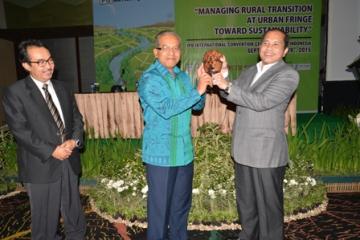
Centre for Planning and Regional Development (P4W) – Institute for Research and Community Service (LPPM), Bogor Agricultural University (IPB) held "The 6th Rural Research and Planning Group (RRPG) International Conference and Field Study in Indonesia 2015" at the IPB International Convention Center (IICC) Bogor, (28-29 / 9). Present to give keynote speech were the Minister of Rural Development and Transmigration, H. Marwan Jafar and IPB Rector, Prof. Dr Herry Suhardiyanto.
The conference was held in an effort to share ideas and best practices by academicians and actors from various countries in the world regarding how the transition of rural areas can be managed in a sustainable manner.
According to Dr. Ernan Rustiadi, senior researcher of P4W LPPM IPB, rural areas have a unique resource with the landscape and agricultural production systems as a result of long interaction between people and the environment, particularly in terms of agriculture and forestry. The existence of these resources becomes an important asset for the lives and livelihoods of rural communities.
Currently, the rural resources, including landscape, are suffering a lot of damage. In addition to the damage caused by agricultural production practices (modernization, intensification, increased scale of production or land abandonment), the destruction also comes from the uncontrolled expansion of urban areas to rural areas (the process of sub-urbanization of rural areas), visible from the emergence of new residential housing and industrial area.
In many cases in various countries, the process of sub-urbanization leads to much faster population growth in the suburbs (fringe area) than the population growth in the city center itself. Culture and lifestyle of the community on the outskirts of the region is experiencing a shift with the dominance of the commuters who live in the suburbs but work in the city center.
In the midst of continuous urbanization and sub-urbanization, the challenge that must now be answered by academicians and rural activists is to get a sustainable transition model for rural areas located around the periphery of urban areas. The intended transition model is to allow urban growth without much convertion of fertile agricultural lands, areas with high diversity. In addition, the change that is occurring is not as far as possible to sacrifice the wealth of its natural landscape, the main production systems and local cultural values. (Mtd)