Rector Invites Students to Discuss and Create Green Campus
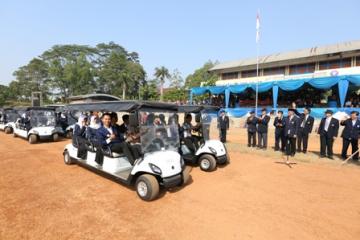
As an effort to create an environmentally-friendly campus of IPB (zero waste, zero emission, rich in bio- and cultural-diversity) and conducive for successful learning as well as safe comfortable in the support of the development of agro-eco-edu-tourism program, IPB introduces “IPB Green Campus 2020”. This pogram is initiated also to develop the behavior of the academic communities toward a Green Culture.
One effort being made is the green transportation system. For this system to run effectively, IPB Rector, Prof. Dr. Herry Suhardiyanto invites the students to discuss the implementation of green transportation, launched on the 1st of SSeptember 2015.
The discussion between Rector and the students was carried out on Thursday (17/9), involving the students represented by the Student Executive Body (BEM) and Student Representative Council (DPM) throughout IPB, Student Consultative Board (MPM) of IPB and Graduate Student Forum (Forum Wacana) of IPB. The meeting was held in the Rector Meeting Room, Rectorate Building of Andi Hakim Nasoetion, Dramaga campus of IPB Dramaga, Bogor.
To promote the green transportation system, some measures are taken such as the use of bicycles, providing more bicycles and bicycle shelters, pedestrian constriction, development of mass transportation, arrangement of private car parking, freeing certain areas from motorbikes and cars, and campaign of green campus as a culture of IPB’s academic community. Motorbikes, particularly, will be arranged on the parking lots provided, namely, the parking areas of the Graduation Building Gedung Graha Widya Wisuda (GWW), Green TV, Faculty of Animal Husbandry and Student Resimen Post (Menwa). As an alternative, IPB provides mass transportation such as electric cars and busses to serve the IPB’s academic communities through five corridors. In the future, the use of buses, electrical cars and parking will be charged for the operational cost.
At this occasion, the students critiqued several aspects of the green campus implementation – concept, transportation tariff, facilities and operational preparation. “In creating a green, why did it start with green transportation, why not to begin with developing mindset and knowledge of the academic communities to care for the environment?” asked Chairman of BEM KM IPB, Dadan. “It is indeed this practice that is strategic; the implementation of this system serves at the same time as learning for us together the importance of green campus. This will become an entry point of education in which many aspects are related such as attitude to energy efficiency, queuing culture, environmental care. The development of this green transportation may well open the way of rearrangement that we must carry out,” explained Rector.
As for the charges or tariffs for the use of busses and electric cars, Rector asserts that the economically weak students will get facilitation, that is, to use the transportation for free. “Rearrangement and adjustment will continue along with the ongoing process of this system; if we are in a rush, the facilities that we are developing might not well be effective” emphasized Rector responding on the operational preparation of the green transportation.
Besides green transportation, to create a green campus, IPB will also look at other elements such as (1) green energy, by cutting electricity derived from fossil fuels (including State Electricity) and replacing with solar cell; there is a possibility to produce biogas and water-powered electricity (MHPP) for the Darmaga campus of IPB; and studies on the development of biomass-based energy; (2) green building & green open space, by reducing the use of Air Conditioning and improving air circulation, re-greening the parking areas for the comfort and beauty of the campus and developing agricultural germ-plasma collection (fruit, wood etc.); (3) green movement/green culture, by changing the mindset, attitude, and behavior of academic communities toward friendly environment through awareness campaign, massive social movement, developing green champions, and others. Other actions to create green movement/green culture are construction of canopies as corridors for pedestrians, creating a zero-waste campus, sorting
and processing waste (solid, liquid, gas, organism); and using easily-degraded materials. (Mtd)