Prof.Dr. Santun R.P. Sitorus: Paddy Field was the Most Easily Converted
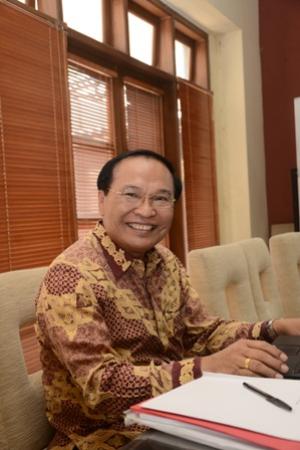
In 1960s, Indonesia had the Act of Basic Agrarian. In the new order era, for the reason of the economic growth, President Soeharto issued a wide variety of Acts that were sectoral. There were Act of Forestry, Act of Transmigration, Act of Agriculture and so on. The problem was all those Acts regulated the land so that it collided with the Act of Agrarian. Additionally, in Area of Eastern Indonesia, the community enforced the land arrangement which was hereditrary, unwritten.
It was delivered by Prof.Dr. Santun R.P. Sitorus, Professor of Faculty of Agriculture of Bogor Agricultural University (IPB) in a press conference of the pre oration in Executive Lounge Campus of IPB Baranangsiang, Thursday (27/8). According to him, when the population increased with diverse needs, the allocation of land was no longer possible and done in the traditional way. It was necessary to evaluate the land resources and to be continued with the land use planning.
The land use planning could be done from the small to the big scales to overcome the problems in the city and the suburbs, the conversion of agricultural to non agricultural.
“Land conversion occurs because of the differences in the economic value of land. Agricultural land use is much lower than the non agricultural, one hectare of paddy field for four months produces only 2-3 million rupiah, compared if used as home or shop, then 100 meters can be more than that,” he said.
Net income which could be obtained from the smallest plot of land of paddy field, if it was bumped right, was very easy to use the converted paddy field. For example in the area of Sindang Barang Bogor, in 60-70s there was still a good paddy field, so when the campus of IPB was in Darmaga the paddy field was no longer hold back over the function. Paddy fields now were transformed into shops, boardinghouses, hotels, and restaurants. The same thing was happened in the area of Jabodetabek, it occured that the area acceleration was built in the region. With the population growth, it occured the overhaul of land use into the developed regions. This was resulting in the emergence of various environmental problems.
“In Indonesia, the process of diversion of land function is very easy and quick. Compared this with the United Kingdom, to change the vast agricultural areas in the developed countries, it is necessary to have the public debate in more than 10 years. Government can not arbitrarily,” he said.
From a study conducted by Prof. Santun, the process of agricultural land conversion in Indonesia was in Java, the paddy field was into housing of 58.7%, the paddy field was into non paddy fields of 21.8%. Outside Java, the paddy field was into housing of 16.1%, the paddy field was into non paddy field of 48.6%.
“In 1973-1980, I am involved in the management of tidal paddy field, now what happens, the land has become the oil palm plantation. So I worry about the adequacy of food and our food resilience would be threatened,” he explained.
Therefore, in a scientific speech which would be held on Saturday (29/8), in the Auditorium of Andi Hakim Nasoetion, Campus of IPB Darmaga, Prof. Santun put forward the theory and the concept of the land use and the land use planning as well as their application to agricultural development, transmigration and urban areas. And ended with the thought of the concept of development to be used in the future. (http://bit.ly/1UgD0Gd)
In the spatial planning and the land use of region, the scientific basis i.e. the land evaluation and the land use planning was needed, so that the land use of region could be optimized sustainably. In the future, the integration of the agrarian arrangement and the spatial planning in the system of spatial planning was indispensable.(zul)
Tag:
Santun R.P. Sitorus, scientific papers of IPB, land management, spatial planning, land conversion, Professor of IPB, Faculty of Agriculture of IPB.