
CIBEST LPPM IPB Held the Training on the Application of Measuring Poverty and Welfare in Syariah Perspective
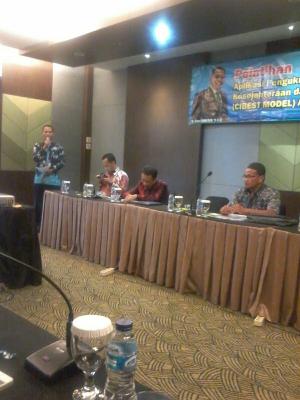
Study Center for Syariah Business and Economics, Institute for Research and Community Services, Bogor Agricultural University (CIBEST LPPM-IPB), held the training on the application of measuring poverty and welfare in syariah perspective (CIBEST Model) followed by 28 participants from various Lembaga Amil Zakat (LAZ) in Indonesia. Training event which was ongoing on Saturday, 30 May 2015 in Seminar Room of PSP3 Campus of IPB Baranangsiang Bogor was opened by Executive Secretary of CIBEST, Dr. Muhammad Findi.
This training was held with a view to measure the level of poverty and household welfare based on the syariah perspective, and also to map out the mustahik to be empowered towards a higher level i.e. muzakky.
The participants that in fact the practitioners of LAZ like BAZNAS Pusat, Dompet Dhuafa Republika, Mandiri Daya Insani, PKPU, Yayasan Baitul Maal BRI, BAZNAS of Pangkal Pinang, BAZNAS of South Bangka, BAZNAS of Bangka Belitung Province, BAPPEDA DKI Jakarta, BAZNAS of West Java Province, Baitul Maal Aceh, BAZNAS of Cimahi City and the academics from the universities, which were very enthusiastic to follow this activity.
As known that the government of Indonesia referred to the poverty standard to Central Bureau of Statistics (BPS) and Coordinating Body for National Family Planning (BKKBN). BPS in the poverty measurement approach based on the basic need approach which was based on individual. While BKKBN in its approach used the qualitative method based on family. BKKBN classified the poor household in 5 categories: Pra Sejahtera (Pre Prosperous), Sejahtera I (Prosperous I), Sejahtera II (Prosperous II), Sejahtera III (Prosperous III) and Sejahtera III Plus (Prosperous III Plus ).
This training introduced a new approach called CIBEST Model, where the household was classified into four possibilities and later called CIBEST Quadrant. This approach referred to the basic needs in syariah i.e. material need and spiritual need. Dr. Irfan Syauqi Beik as the trainer and the inventor of this CIBEST Model explained that the basic needs in syariah were capable of conducting worship, fulfillment of food and clothing, and loss of fear in certain environmental condition. Based on the verses of Al-Qur’an, CIBEST Quadrant was composed. Quadrant I: Prosperous (QS An-Nahl 97), Quadrant II: Poor of Material (QS Al-Baqarah 155), Quadrant III: Poor of Spiritual (QS Al-An’am 44) and Quadrant IV: Poor of Absolute (QS Thaha 124).
Material Poverty Line (MV) was measured by three approaches: minimal needs survey (clothing, food, shelter, health and education), a modified approach to BPS, and a nisab standard (taken an approach that allowed). While Spiritual Poverty Line (SV) was measured with the scoring to the indicator of spiritual minimal needs of household from 1 to 5. The Spiritual Needs included the fardlu ‘ain needs, the families and the government policies.
Based on CIBEST Quadrant above, then it was drafted the index of each quadrant. Prosperity Index where the conditions of households could meet both the needs of material and spiritual. Material Poverty Index where a household could meet the spiritual needs but the aspects of material needs were not fulfilled. Spiritual Poverty Index where the households could meet the material needs even abound but the poor would be for the aspects of spiritual needs, and the last, Absolute Poverty Index, i.e. the households were not able to meet both those needs.***

