
STAKEHOLDER DISCUSSION Dampak Kenaikan Bahan Bakar Minyak (BBM) Terhadap Sektor Pertanian Secara Luas
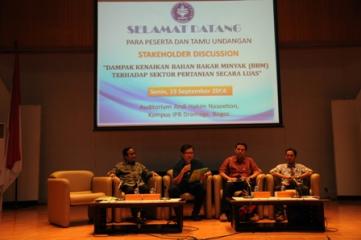
Fuel is a strategic commodity, which people often referred to as "black gold". Black gold is a term applied to oil or petroleum, which is black when it comes out of the ground and is worth a great deal of money. To show how important this commodity for us, on Monday, 15 September 2014, at the Auditorium Andi Hakim Nasoetion, Campus IPB Dramaga, Bogor, Directorate of Agricultural Policy and Strategic Studies (DIT. KSKP) held a Stakeholder Discussion on “Dampak Kenaikan Bahan Bakar Minyak (BBM) Terhadap Sektor Pertanian Secara Luas (The Impact of the Increasing Fuel Price for the Agricultural Sector)”.
"The objectives of this discussion are to explore the impacts, policies and strategies of the proces to increase the fuel prices, especially its impact on the agricultural sector in the broad sense. It is expected this discussion will recommend a formula to determine fuel prices, particularly for the agricultural sector ", said Director KSKP, Dr. Ir. Dodik Ridho Nurrochmat, M.Sc.Trop in his report.
Rector of Bogor Agricultural University, Prof. Dr. Ir Herry Suhardiyanto, M.Sc in his remarks and who officially opened the event, said, "The agricultural sector will be unlikely to become a main driver to lead the nation’s economy, and to run this sector it will require fuel. Therefore, policies to raise of fuel prices should not interfere the agricultural sector, particularly food production. As we understand that agriculture is a crucial issue to people’s lives. Thus, this present discussion should be able to solve the existing problem and will recommend solutions, ideas and future innovation for the development of stronger food production, efficient and modern, ".
Three speakers who are concerned on the impact of the increasing fuel prices for the agricultural sector at large were invited for the discussion. First speaker was, Dr. Rusman Heriawan, deputy Minister of Agriculture. In his paper presentation he stated "The increasing of fuel prices will affect the the development of agricultural sector, Indonesia should not be separated from the development of agricultural infrastructure, agricultural competitiveness, the glory of agricultural, as well as prosperity of the people of Indonesia. To develop agricultural sector, it should be strongly supported by technology and agricultural innovation, to enable them to be planned and measured, for better socio-economic impact and comprehensive social safety networks. "
The second speaker was Dr. Nunung Nuryartono, the Director of InterCafe IPB. During which he stated that, "The raising of fuel prices will reduce the purchasing power of the people, especially the lower classes. Therefore, the reduction in fuel subsidies should be diverted to the productive activities, especially agriculture. Stabilization of the prices of basic necessities, especially food, is really required. Moreover, providing compensations for labors and poor farmers is a must to avoid them being hit by the impact of the fuel price hike. Finally, policies to raise fuel prices must be established."
The third speaker was, Mr. Luqman Hakim, MH., chairman of Asosiasi Pateani dan Nelayan (Farmers and Fishermen Association), during which he stated that, "The most important things to do is how revitalize farmers to enable them to work properly. Willingness to assist farmers from upstream to downstream by providing access to knowledge about organic technology. With regard to capital and markets, we should encourage the government to establish policies to protect farmers from all sorts of threats that undermine farmers. When everything are OK, we will begin to transfer the fuel subsidy for the agricultural sector, which might be in the form of subsidies for their agricultural products, provide capital for farmers, the development of appropriate infrastructure (irrigation, roads), procurement of machineries for farming (harvesting machine, and planting machine), and develop agro-based renewable energy. "
On the other hand, behind the walls of campus and research centers, researchers are anxious to think on the impact whenever we run out of fuel. However, human civilization is completely dependent on oil. As fuel commodity, oil is inexhaustible renewable goods. The world must live without BBM. (Wied).

