Protect the Poor People in Indonesia
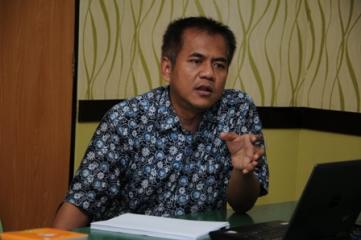
Tomorrow will be the important day in the life of Prof.Dr.Ir. Noer Azam Achsani, as tomorrow, 20 September 2014, he will be promoted to take his Professor Chair on Economics of Bogor Agricultural University (IPB). In the inaugural ceremony, Prof. Noer will present his scientific paper on "Tantangan Baru Ekonomi Politik Indonesia Menghadapi Problema Lokal dan Dinamika Global (New Challenges of the Political Economy of Indonesia Toward Local and Global Dynamics" at the Auditorium Andi Hakim Nasoetion, Dramaga campus, Bogor.
Earlier, Prof. Noer explained the overview of his oration for journalists in the Press Conference held on 19 September 2014, in the meeting room of Academic and Education, Dramaga Campus, Bogor. Prof. Noer expressed the position within the future political constellation in Indonesia.
"Behind the success story of Indonesia to reach its 10th position in the world (World Bank, 2014), the Indonesian economy is still facing severe problems including poverty and unemployment, inequality, issues of debt and dependence on foreign countries," he said.
Poverty, in the year 1999-2013 poverty gap has widened significantly between rural-urban (rural is generally poorer than the city). Most of poor people in Indonesia are concentrated in Java. The concentration of the poor in Java reaches 56% of the total poor population in Indonesia. Sumatra regions is ranked into the second, it reaches 23% of the total poor population in Indonesia. Nearly 78% of poor people live in those two islands, especially in rural areas
Gap, the Indonesian economy in 1997 was marked by the high post-crisis welfare inequality. Economic disparities between regions and between sectors.
"Eight provinces with the inequality above the national average in 2013 was North Sumatra, Jakarta, South Sulawesi, Southeast Sulawesi, West Papua, Yogyakarta, Gorontalo, and Papua. The most province which is hit by inequality is Papua, with 0.44 ratio. Java, which covers only 6.8% of Indonesia occupied 58% of the population and accounted for 58.7% to the GDP of Indonesia in 2010, contrary to Maluku and Papua, which covers an area of 26% Indonesian territory occupied only 2.4% of the population and accounts for about 2, 6% of GDP in Indonesia in 2010, "he explained.
Economic gap between sectors is also remarkable. The agricultural sector contributes only has 14.3% of the total GDP but absorbs 35% of the workforce (farmers in the village). While the industry sector, accounted for 26.1% of GDP is only absorb 13% of the workforce.
"Agriculture is the sector that enjoys lowest level of prosperity. Compare with other sector, such as mining, workers of this sector have enjoyed 20 times more prosperity than those at the agricultural sector. These data indicated that the economic transformation is not followed by the transformation of employment. In fact, the agricultural sector should carry a very heavy burden. In addition, the agricultural sector became the biggest container for low-educated human resources. It is inversely proportional to the financial industry, energy services and human resource which is full of innovated people, "he said.
Debt problems, the national economy Indonesia after 1997 economic crisis had resulted massive debt problems, both foreign and domestic debt. In January 2014, the government debt position amounted to USD 127.9 billion and domestic debt of Rp. 734.4 Trillion. If coupled with the debt of private sectors (USD 141.1 billion), with the exchange rate of USD 1.00 = Rp. 11,500, thus total debt of Indonesian reached Rp 3,800 trillion.
Foreign debt is very dangerous for Indonesia, as it will drag the country in a self fulfilling inflationary crisis, as a result of short-term domestic public debt. In addition, foreign debt has the potentiality to cause panic as it was happened in Mexico and South Korea, when those countries experienced financial crisis due to the collapse of the fixed exchange rate regime on 997-1998. Plus, the danger of currency mismatch that effect to the balance of payments. In terms of dependence on foreign countries, our economy is vulnerable to external disturbances as well as large amounts of capital flows and the amount of exports and imports.
"There are a number of challenges that may hinder Indonesia in fulfilling its business and investment potential, namely the ASEAN Economic Community (AEC) 2015. Under the AFTA agreement, it appears that ASEAN member countries is a single economic area without frontiers. When the ASEAN Economic Community (AEC) is implemented in 2015, not only commodities and services will move freely within the region but also other products, including manpower. What Should We Be Worried About? Plenty of smart people with large capital from abroad are coming into Indonesia, but we will experience brain drain as plenty of our Indonesian smart people leave the country to get higher salaries in other ASEAN member countries. Thus, they will make other countries such as Japan, China, Singapore, Korea, Malaysia, Vietnam and the Thai will be getting more advanced than Indonesia. While Indonesia, Myanmar and the Philippines will be left behind. Brunei will be excluded in this term, "he explained.
Of course, the poor will be suffering the most of such situation. Efforts should be planned to counterfeit any issues on domestic problems and global challenges of the future. Indonesia needs to formulate the new socio-economic policies. Government must assist the poor to increase their access to the sources of economic growth, especially land ownerships, banking and financial services. Then improve their access to quality education and health as well as to provide more opportunities for community empowerment to improve their income.
"The ASEAN member countries are now in the phase of accelerating their preparations in the run-up to the AEC 2015. With the rapidly changing socio-economic global landscape, there is a greater sense of urgency and commitment among ASEAN countries to push ahead with fresh approaches to ensure that the newer members – Cambodia, Laos, Myanmar and Vietnam (CLMV countries) – are not left behind. Investment and technical supports from other sub-regional for less fortunate member countries including Indonesia are really required. Due cognizance must be given to such sub regions which are in dire need for development assistance. It’s not free, Indonesia might not expect the kindness of other countries but have struggled through negotiations both bilaterally and multilaterally, "he concluded. (Wied).