
KSKP IPB Held the Fertilizer Subsidy Policy Reform Discussion
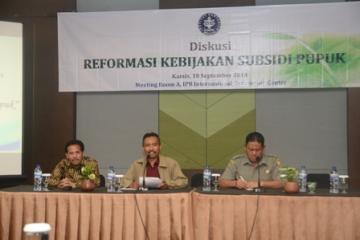
Directorate of Strategic Studies and Agricultural Policy (KSKP) Bogor Agricultural University (IPB) held the discussion with the title of “Reformasi Kebijakan Subsidi Pupuk / Fertilizer Subsidy Policy Reform” in the Meeting Room A IPB International Convention Center (IICC) (18/9). On this occasion, the presentation was delivered by Dr. Ir. Sumardjo Gatot Irianto, MS, DAA (Director General of Agricultural Infrastructures, Ministry of Agriculture) and Dr. Ir. Arif Daryanto, M.Ec (Director of Graduate Programs in Management and Business of IPB). Meanwhile, Dr. Ir. Suryo Wiyono, M.Sc.Agr (Head of Sub Directorate of Agricultural Policy, KSKP IPB) was as a moderator.
This activity was expected to produce a formulation of the fertilizer subsidy that had a good degree of implementation quality in the effectiveness and the efficiency. Director of KSKP, Dr. Ir. Dodik Ridho Nurrochmat, M.Sc stated, "The fertilizer subsidy is part of the nation’s major problems. Total agricultural subsidy is less than 15 percent. The problem is not the subsidy. But it is the effectiveness and the efficiency of the use of the subsidy. In a good and happy forum we should be able to discuss the experiences of the colleagues from the various fields with the aim of the more prosperous farmers."
Dr. Sumardjo explained about the Fertilizer Subsidy Policy Reform. “Fetilizer subsidy problems amongst all are the limited budget allocation and the need is still high, but High Retail Price (HET) is relatively fixed. Not to mention, the Government Purchasing Price (HPP) increased, the purchasing power of community is limited, the Definitive Plan for Group Needs (RDKK) is weak without the limit of clear need, and the monev distribution system and the supervision are weak. Problem solving efforts amongst all are the HET is gradual and planned approximated by HPP/adjustment of HET, the rationalization of the distribution chain and kiosk, the development of rational NPK compount fertilizer, the sovereign fertilizer production, the people and land-based subsidies”, said Dr. Sumardjo.
Fertilizer subsidy had its own pattern, the large price disparity between the subsidy with the market price caused a lot of negative things that appeared. To overcome this could be done by minimizing the disparity, formulating the fertilizer and improving the base of subsidy determination.
On this occasion, Dr. Arif explained the Pattern of Subsidy and Fertilizer Distribution System in Indonesia. Then Dr. Arif stated, “Alternative policy proposed in the technical aspect is by increasing the accuracy of the use of the fertilizer and improving the efficiency of the use of the organic fertilizer. In the aspect of management, there is a need to increase the accuracy in the determination of the allocation of subsidized fertilizer need, to increase the monitoring and the oversight of procurement and distribution of subsidized fertilizer, and to increase the accuracy of subsidized fertilizer distribution. In the regulation aspect, the functioning RDKK as the tool in the planning and supervision of subsidized fertilizer distribution establishes a clear criminal sanction for violators of the provisions of subsidized fertilizer distribution and the reposition of subsidized fertilizer distribution as goods in surveillance.” (RF)

