Indonesian Lacks of Taxonomy Experts Monday, September 22, 2014
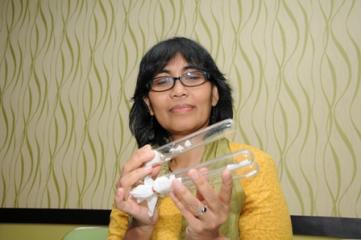
Of about 2000 entomologist owned by Indonesia, only 875 are active in the Entomological Society of Indonesia (PEI). And of that number, only 20 are taxonomist. It is not enough for the biological richness of Indonesia.
"It means nothing as we have a wealth of natural resources but no one cares and maintains it because we are only a few taxonomists. We should have the taxonomic experts who are ready to protect and preserve our biodiversity," said Professor of Plant Protection, Bogor Agricultural University (IPB), Prof.Dr.Ir. Damayanti Buchori, MS in the Press Conference on three Scientific Speeches by new Professor of IPB in Darmaga Campus (19/9).
In the scientific speech that will establish her as one of IPB’s Professors in the following day, Prof. Damayanti raises the topic "Biological Control and Insect Conservation for Development of Green Indonesia".
Nature has provided a very important key factor, which can be used to solve pest problems. It is the presence of natural enemies of pests that can prey on pests so that they can not breed. The natural enemies of insects are those who are active to seek, become the parasites of and prey on or kill pest insects.
"This technology is a biological control. This is a form of utilization of organisms (predators, parasitoids, and pathogens) to suppress the population density of another organism. Unlike other pest control techniques (chemical control), which rest on the eradication process, the biological control focuses on the suppression of pest population to a low density so as to create the ecosystem balance. Natural enemies often used are of two types of prey (beetles, ladybugs, ants, praying mantis) and the parasitoid type (wasps)," she said.
This concept, although it is old, is becoming a new trend in academic circles abroad. It has even developed to the so-called ecological engineering or ecological intensification.
This biological control has great prospects on filed, but this technology is not quite popular and does not have a place among farmers and agricultural companies. The reason is that the government regulation is not strong to support the implementation of biological control, and this technology requires perseverance and the minimum requirements of the necessary knowledge and agricultural paradigm, that is, the conventional farming becomes the farming that supports the principles of landscape-based conservation.
According to her, Indonesia requires the policy to ensure that the useful insects (biological agent) are safe and continue to survive on the landscape. What happens now is the opposite as the policy makers are separate – some are in the Ministry of Forestry and others in the Ministry of Agriculture.
"Although there has been the Aquaculture Act of 1992 governing the control of pests using an Integrated Pest Management (IPM), but there has been no PP (government regulation) derivatives until now. What is happening is when exporting its agricultural products, Indonesia is rejected on because of the high content of pesticide residue. There need to be science-based policies on fundamental things we must do to achieve welfare," she said. (Mtd)