IPB Students Create Plastics from Corn Skin or Husk
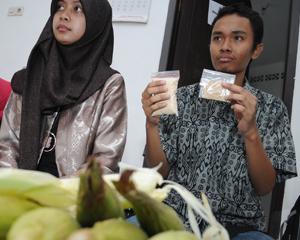
IPB’s students have successfully created plastic from corn husk. The idea starts from the abundant waste of corn husk disposed in Bogor market. They feel challenged to reduce the environmental pollution caused by the abundant use of plastic in daily life, so its usage should be minimized.
Students of the Department of Physics, Faculty of Mathematics and Natural Sciences (F-MIPA) IPB, Made Dirgantara, Miko Saputra, Eni Septi Wahyuni and Muhammad Khalid did a creative work in the Student Creativity Program (PKM) by making plastic from corn husk.
Until now, klobot or corn husk in Indonesia has widely been used as animal feed, traditional food packaging , and traditional crafts. However, the skin of corn has another role that has not been utilized.
The making process starts with drying the corn husk in a oven with the temperature of 60 degrees celsius for 8 hours. Once the skin is dried, it is milled to resemble flour. After that it is mixed with plastic ore material and oleic acid using extrusion machines and then pressed to produce bioplastic.
According to Eni Septi Wahyuni, her research results show that corn husk contains fiber and starch that can be used as a material to make plastic. Further, the plastic that she produced could decompose by microbes within 2 months after the test, making it more environmentally friendly, she said in the coffee morning meeting held at the Forum Secretariat of Bogor Daily Journalist.
Eni Septi Wahyuni said, if any employers are interested, they could apply this innovation to produce interior utensils such as coasters, disposable food and beverage containers as well as knick knacks from plastic. But the aspect if durability needs further research (Mtd)
.