Indonesia will become the Vulnerable country if Rely Only on One type of Staple Food
In the opinion of Prof.Dr.Ir. Purwiyatno Hariyadi, the food diversification promotion program has never successfully changed the food consumption patterns of the people of Indonesia. If we depend only on one type of staple foods, it will be too risky for Indonesia. Therefore, there should be a strong incentive for successful diversification program. In such cases, the food industry should be encouraged to produce processed food products based on local raw materials as Indonesia is very rich with them.
Prof. Purwiyatno added, when we talk about food diversification we don’t want to change the goal that reduce the rice consumption, but to make the menu more nutritious. "Now our food menu is still dominated by rice. More foods should be produced that are rich in all the essential micronutrients, available in sufficient quantities and accessible to people all year round. We have to change our food consumption patterns, as of eating lots of rice is not good for our health. Many people lack adequate amounts of foods that are rich in the nutrients needed for health and a productive life. The wide application of proven technologies and approaches in these fields, as well as the development of new concepts, will contribute towards solving nutritional problems. We may adopt the successful communication model of wheat as the alternative staple food, he stated.
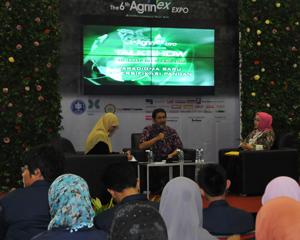
He added, that more foods should be produced that are rich in all the essential micronutrients, available in sufficient quantities and accessible to people all year round. Further, food products other than rice should be easily processed and attractive. Clasically, food diversification program promoted produced other foods that requires more efforts in its process compared to rice, "said chairman of SEAFAST Center, LPPM IPB who was invited as the guest speaker on the talk show on “New Paradigm for Food Diversification” in the Agrinex 2012 Jakarta Convention Center.
According to Ir. Gayatri K. Rana, MSc, Head of Consumption Diversification and Food Safety, National Food Security Agency, said "In the 1950s, the staple food of rice was only 50%, others commodities such as maize, cassava, and sago. Then 30 years later, rice has contributed about 80%. Now, almost 100% of our staple food is rice. Nowadays children know that their staple food is rice, "he said.
He stressed, historically the food diversification program has long been promoted. Cultural factor has been the dominant factor for the successful implementation of the promotion. "It is not an easy way to change the culture, however we should never stop the program . Efforts should be continuesly implemented, "he said. (Wied).