Dahlan Iskan Challenges IPB’s Students to Design Seaweed Industry
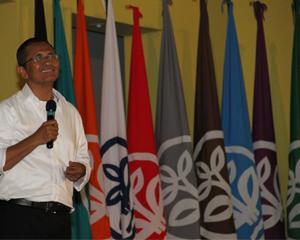
Minister of State Enterprise, Dahlan Iskan, challenges the students of Bogor Agricultural University (IPB) to create a design of seaweed industry. "Last week I visited Bulukumba, South Sulawesi. There, the fishermen grow seaweed. A fisherman family will live sufficiently when cultivating seaweed on 2000 plots. One plot is 100-200 meters long. Unfortunately the fishermen there can only cultivate 300-1200 plots due to lack of capital. I then asked BRI to provide the capital for fishermen, in order to increase the plot size of seaweed," he said as a guest speaker in the “Public Lecture with Dahlan Iskan” held on Tuesday ( 17/4) in IPB Darmaga campus, in the commemoration of 60 years after the laying of the First Stone in the Construction of Baranangsiang Campus and Higher Education of Agriculture
Dahlan also regrets that the fisherman has been selling the harvested seaweed in the raw form without being processed into flour first. "Therefore in the next year I will set up the first seaweed processing industry in Indonesia in Bulukumba. In relation to that, I challenge IPB’s students: If within this year you can make a design of the seaweed industry, I’ll give a car as the reward," said Dahlan responded with the applause of more than 3000 attendants.
Dahlan also challenges IPB’s academic communities to find a solution to the failure of pineapple cultivation on thousands of hectares in Kalimantan. "I have lost billions of dollars there. I thought growing pineapples was very easy; it turns out that it requires knowledge. I hope IPB could help," said Dahlan.
The challenge does not stop there. The academicians are challenged to develop technologies that could change the sago in Papua into rice-like grains. Unexpectedly a student of the Department of Food Science and Technology, Faculty of Agricultural Technology, IPB, Anisa answered the challenge. She presented analog rice developed by the students and lecturers of IPB. It is a combination of rice, sago, corn or other carbohydrate sources whose nutritional content can be adjusted according to the needs of consumers. With a joyful manner, Dahlan received the analog rice. "Tomorrow morning I will cook it and I will eat it. No matter if it does not yet smell like rice. No problem how it tastes because it takes a further process, but I am very happy with this innovation," said Dahlan.
Dahlan then asked Rector of IPB for his permission to send the analog rice innovation team to take comparative studies abroad. "Mr. Rector, I asked for your permission, Could I send the analog rice innovation team overseas? If you allow and wish, they can directly go tomorrow," said Dahlan. IPB Rector, Prof. Dr. Ir. Suhardiyanto nodded his head signaling agreement.
According to Dahlan, such a technology and innovation is so much awaited from IPB to promote agriculture in Indonesia. Dahlan said Indonesia would not be able to beat China in terms of exports of fruits, electronics, toys, and so on, because they have a vast agricultural land supported by a lot of human resources. "But Indonesia can beat the Chinese in terms of exports of tropical fruits. They need a lot of tropical fruits. I believe we can export tropical fruits there. We must look at the potential of Indonesia which is not possessed by another country,” added Dahlan. This is where IPB is needed to develop various findings related to tropical agricultural commodities.
On that occasion, Rector of IPB said the presence of Dahlan Iskan in the public lecture is indeed expected to deliver a breakthrough of a new idea in the development of agriculture in Indonesia, amid the many imported products of agriculture from various countries. "Coinciding with the 60th Year of Laying the First Stone in the Construction of Baranang Campus, I hope the whole community understands how important the contribution of agricultural higher education is to this country to meet the food needs," said Rector.
Before the lecture, to trigger the motivation to develop agriculture, the audience were shown a documentary film about 60 Years of Higher Education of Agriculture, proceeded by the introduction to the film by the first batch of IPB, Prof. Utomo Karsosuwondo. (Mtd)