IPB University Strengthens GRC, a Strategic Step in Responding to the Complexity of Modern Higher Education Governance
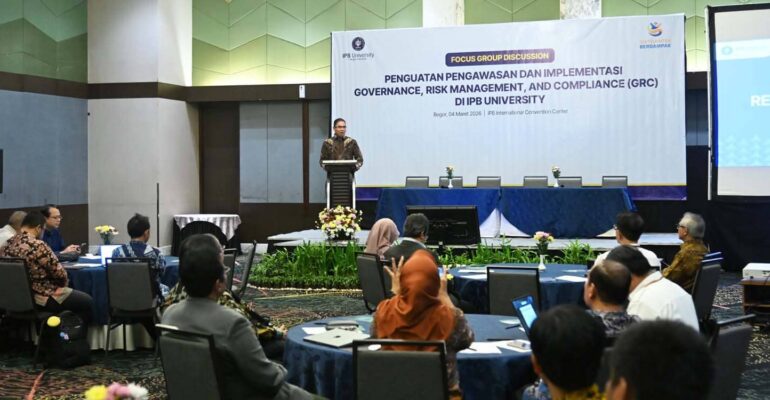
IPB University affirms its commitment to strengthening governance, risk management, and compliance (GRC) as an integrative strategy in strengthening institutional governance, risk management, and compliance.
This commitment was conveyed at the GRC Supervision and Implementation Strengthening event held at the IPB International Convention Center (IICC), Bogor (3/4). The strengthening of GRC is a recommendation from the Audit Committee through the Board of Trustees (MWA).
The Rector of IPB University, Dr Alim Setiawan Slamet, said that the complexity of higher education today is not limited to the implementation of the three pillars of higher education, but also includes the management of innovation ecosystems, global collaboration, business, investment, and digital transformation.
“Governance is no longer just a matter of compliance, but also concerns the sustainability of the institution,” he said.
Five Strategic Agendas
Furthermore, Dr Alim outlined IPB University’s five strategic agendas for the future, namely scientific and institutional transformation, expansion of access and quality improvement, strengthening of impactful research and innovation, global engagement, and resource and governance resilience.
The transformation of study programs and divisions is considered important. The current number of study programs, which has reached 177—more than 100 of which are postgraduate programs—is considered inefficient compared to other universities.
In terms of access, he highlighted the importance of regional equity through national selection channels. In addition, the strategy of developing virtual education and digitizing 4.000 courses is aimed at supporting micro-credentials and lifelong learning.
In the field of research, he explained, IPB University encourages improving the quality of reputable publications and institutional integration of innovation so that downstreaming and commercialization can be accelerated optimally.
Dr Alim emphasized that GRC is the foundation for ensuring accountable, transparent, effective, and risk based governance.
“Without strong governance, organizations will lose direction. Without good risk management, organizations are vulnerable to uncertainty. Without compliance, organizations will lose trust,” he said.
Meanwhile, Vice Chair of the MWA Audit Committee, Dr Gendut Suprayitno, said that governance transformation was carried out comprehensively, including changing the Risk Management Office to the Governance and Risk Management Office.
“Risk is not only a process risk, but also a management risk and a governance risk. Therefore, we need to map risks from a governance perspective and make improvements,” he said.
He emphasized that every line, from the rectorate, dean’s office, directorate, to the unit, must play a role as risk owners. Every performance target must have key performance indicators (KPIs), as well as key risk indicators (KRIs) and key control indicators (KCIs), he said.
“Once we have objectives, we have risks. At the same time, we have KPIs, and we must also have risk indicators and control indicators,” he explained.
Dr Gendut also emphasized the importance of integration through the three lines model, which now emphasizes a proactive approach. The first line as the implementer, the second line as the risk and quality management function, and the third line as internal audit must be coordinated in a single system orchestration.
“All planning is now risk-based. From planning, implementation, to auditing, everything must be integrated. Governance makes risk-based decisions, which means there must be risk mapping data in every unit,” he said. (dr) (IAAS/FHD)