Discussing Ramadan Astronomy, IPB University Professor Says Earth is Just a Speck of Dust in the Universe
Determining the beginning of the Hijri month, including Ramadan, cannot be separated from the highly precise yet complex dynamics of the solar system’s movements.
Highlighting this phenomenon, Professor Husin Alatas from the Faculty of Mathematics and Natural Sciences (FMIPA) at IPB University thoroughly discussed these dynamics in the recent Ramadan 1447 H podcast titled “Harmony of Earth, Moon, and Sun.”
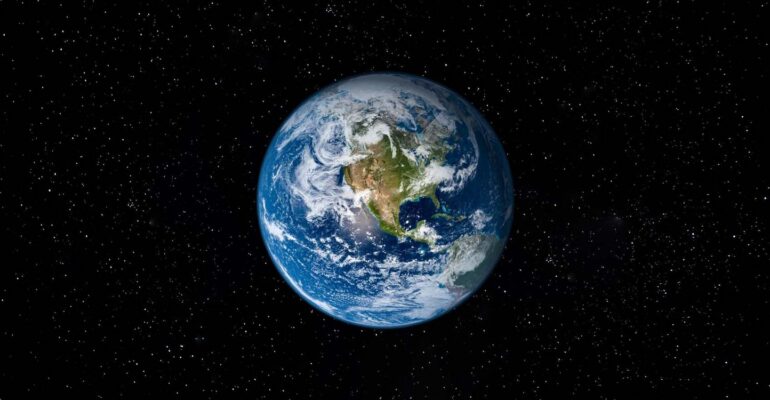
Professor Husin began his presentation by inviting listeners to view Earth from a cosmic perspective. He likened Earth to a quark when compared to the observed universe, which has a diameter of 93 billion light years.
“The ratio of Earth’s size to the universe is 10⁻²⁰. From the Voyager spacecraft’s photo taken at a distance of 4 billion kilometers, Earth appears as a pale blue dot,” he explained.
According to him, this fact conveys a profound moral message that humans are actually very small. However, thanks to God’s nature of Rahman and Rahim, humans are still given the ideal physical conditions of Earth as a home for life, complete with a magnetic field that protects them from the deadly radiation of the Sun.
Regarding the determination of time, this theoretical physicist explained the dynamics of the Earth and Moon’s movement, which travel at extraordinary speeds. The Earth rotates at a speed of 1.670 km/hour and revolves at 107.208 km/hour.
“Interestingly, the Moon’s rotational and revolutionary speeds are the same, namely 1.040 km/hour. It is this physical condition that causes us on Earth to always see the same side of the Moon’s surface,” explained Prof Husin.
In the Hijri calendar or the determination of the beginning of Ramadan, he explained that the cycle used is the synodic period, not the sidereal period.
“The synodic period, which takes 29,5 days, is the time it takes for the Moon to return to the same phase, when measured based on the relative positions of the Earth and the Sun,” he explained.
Furthermore, he explained that the gravitational interaction between the Sun, Earth, and Moon forms a very complex three-body system.
In physics and mathematics, this system has no exact solution that can predict its movement with perfect precision indefinitely.
“Although the dynamics of this system are very difficult to predict for a very long period of time, its movement can be predicted very accurately for a short period of time. This is the scientific basis for the astronomical calendar for determining the beginning of the month,” he said.
Through this explanation, he hopes the public can see the phenomenon of determining the start of Ramadan not merely as a religious routine. More than that, this moment is a space for contemplating nature that combines pure astronomical science with profound spiritual wisdom. (RHF) (IAAS/SSR)