PKSPL IPB University Discusses Coastal Land Conversion in Commission IV of the Indonesian House of Representatives
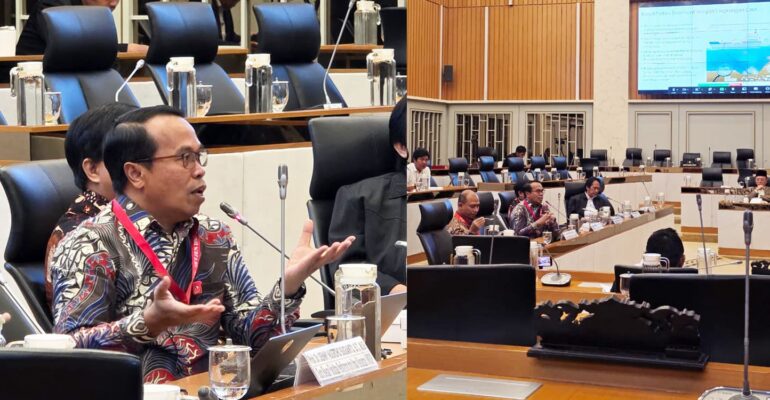
The disasters that have occurred in recent years are important to note because they are related to land conversion, including in coastal areas. Several issues of land change due to abrasion, accretion, reclamation, and unsustainable development have come under the spotlight.
During a hearing (RDP) of Commission IV of the Indonesian House of Representatives (DPR) on Tuesday (I/27), the Chairman of the Center for Coastal and Marine Resources Studies (PKSPL) at IPB University, Prof Yonvitner, said that there are two important components that influence coastal land use.
First, unsustainable economic development, one of which is the policy on the utilization of marine sediments. According to Prof Yonvitner, this policy does not provide adequate economic benefits because the externalities that must be paid are very high.
“In addition, changes in the substrate and ecological chain have also been greatly affected. Furthermore, the economy of fishing communities is under threat, due to the loss of income and earnings caused by limited access and fishing locations,” he said during a presentation at the House of Representatives Commission IV.
Second, weaknesses in development policy management. He highlighted the incident of coastal fence occupation. A year after the sea fence incident, no one has been held responsible, only weak parties who feel guilty for giving others permission to make certificates.
“When viewed with the naked eye, the purpose of the sea fence is to occupy the sea, which can then be reclaimed. The reclamation process is part of the effort to occupy coastal land,” he said.
This hearing was chaired by the Chairperson of Commission IV of the Indonesian House of Representatives, Siti Hediati Soeharto, together with the Vice Chair of Commission IV of the Indonesian House of Representatives, Alex Indra Lukman, and Abdul Kharis. The meeting was also attended by various other speakers from various other universities.
Some important topics discussed in this hearing included weaknesses in supervision and effective forms and strategies for anticipating land conversion. In addition, strengthening and coordination among various parties is also necessary, especially at the regional level.
The discussion was concluded with a spirit of collaboration and synergy among various parties, so that data-based policy strengthening will remain a guiding principle for future policies. (*/Rz) (IAAS/EPK)