IPB University Innovators Design Location Specific Agricultural Machinery to Support Agricultural Machinery Independence
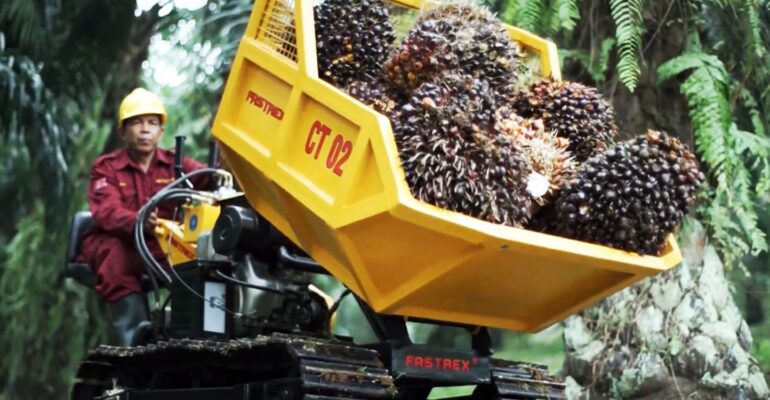
IPB University innovators continue to innovate in developing agricultural tools and machinery (alsintan). One of them is Prof Desrial, an expert in Agricultural Engineering at IPB University, who has successfully created a number of agricultural machines tailored to the characteristics of Indonesia’s locations.
For oil palm plantations, he designed a fresh fruit bunch (FFB) transporter vehicle named Fastrex. This machine is specifically designed for the conditions of Indonesian oil palm plantations, which have diverse land contours and soil characteristics.
“Fastrex has proven to increase the efficiency of harvest transportation, reduce the manual workload of workers, and increase plantation productivity, with a performance of 10-15 tons of TBS per day or the equivalent of 5-7 people with angkong transport tools,” said Prof Desrial.
Furthermore, this innovation has been successfully commercialized, proving the success of downstreaming mechanical engineering research into national agricultural machinery products.
In addition, he has also developed smart tractors and precision agricultural automation technology based on navigation and automatic control systems. This technology enables more precise work paths, efficient use of production inputs, and reduces dependence on skilled operators.
“This innovation is an important foundation for the implementation of digital agriculture and smart agriculture in Indonesia,” he said.
In a global context, he explained that China is currently the country with the largest agricultural machinery production in the world. However, in terms of technological mastery, the United States still occupies a leading position in the development of agricultural tools and machinery.
“In Asia, India is an interesting example because it has succeeded in becoming the third largest producer of agricultural machinery in the world, driven by large domestic demand and massive production scale,” he explained.
What about Indonesia? As an agricultural country with a large area, he believes that Indonesia is still not optimal in developing its agricultural machinery industry. Until now, most agricultural machinery still depends on imports, especially for key components such as engines.
Therefore, a number of innovations that he has developed not only improve work efficiency, but are also important for strengthening the national agricultural machinery industry, which still relies on imports.
However, he believes that Indonesia is actually not inferior in terms of resources and engineering capabilities. “The main challenge lies in strengthening the industrial ecosystem, policy support, and increasing collaboration between universities, industry, and government so that local agricultural machinery manufacturers can develop and compete,” he said. (dh) (IAAS/EPK)