Professor at IPB University: Indonesia Needs a Systemically Built Feed Protein Production Architecture
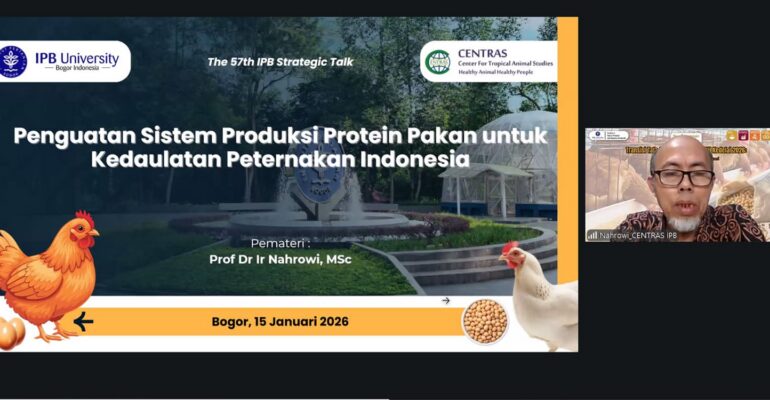
Indonesia is considered to need a systemically built feed protein production architecture to reduce its dependence on imports, particularly soybean meal (SBM).
This was conveyed by Prof Nahrowi, Chairman of the IPB University Tropical Animal Study Center, during the 57th IPB Strategic Talks event themed “Transition of Soybean Meal Import Governance 2026: Implications and Adaptation Strategies,” which was held online via Zoom Meeting at the IPB Dramaga Campus, Bogor, on Thursday (1/15).
Prof Nahrowi explained that Indonesia has abundant biomass. Unfortunately, most of it is still used as an energy source, not as a protein source. In fact, he said, there is a great opportunity to develop domestic feed protein sources.
According to him, dependence on SBM imports causes feed protein prices to fluctuate and tend to increase. “The SBM import policy has positive and negative impacts. If soybean prices rise upstream, the impact is immediately felt downstream. When feed prices rise, it is usually difficult for them to fall again. Import dependence causes this condition to repeat itself,” he said.
He added that the national feed policy has so far focused on corn self-sufficiency as an energy source. Meanwhile, strategic protein sources are considered very fragile because they are not yet strongly owned domestically. “This means that energy sources are relatively secure, but feed protein sources are not,” he said.
A Roadmap is Needed
Prof Nahrowi also highlighted the lack of a roadmap for the development of national feed protein sources. Without a clear roadmap, policies will continue to be implemented without a definite direction. “IPB University continues to conduct research on the revitalization of local feed by shifting from corn-soybean-based formulations to alternatives such as palm kernel meal, koro beans, and maggots,” he said.
This development, he explained, covers aspects of material availability and quality, production scale, utilization of oil palm replanting land for pea cultivation, and maggot development in terms of price and business model so that it can be accepted by the market. However, he acknowledged that the business model for alternative protein sources is still a challenge.
Another source, Prof Dedi Budiman Hakim, Chairman of the Center for International Economics and Applied Finance Studies (InterCAFE) at IPB University, explained that the policy of transitioning soybean meal import management has pros and cons. On the one hand, management by a single company is considered to stabilize prices. However, on the other hand, questions arise regarding the readiness of infrastructure and distribution.
According to him, this policy is necessary because soybean meal prices are highly volatile and risky, with a direct impact on producers, livestock consumers, and the wider community. “Soybean meal prices are unstable, supplies are uneven, and trading patterns are highly volatile, requiring government intervention,” he said.
Meanwhile, Director of Strategic Studies and Academic Reputation at IPB University, Prof Anuraga Jayanegara, said that the government’s policy of transferring SBM import authority to state-owned enterprises (SOEs) has raised concerns among national poultry business players.
“This policy has the potential to disrupt the smooth supply of feed, increase production costs, and impact the sustainability of the national poultry industry, which has achieved self-sufficiency for more than a decade,” he said.
Prof Anuraga hopes that the results of this discussion can be formulated into comprehensive policy recommendations to be proposed to the government, particularly regarding the transition of SBM import management in 2026. (dh) (IAAS/SSR)