
Komnas HAM and PSP3 IPB University Affirm that Food is a Human Right
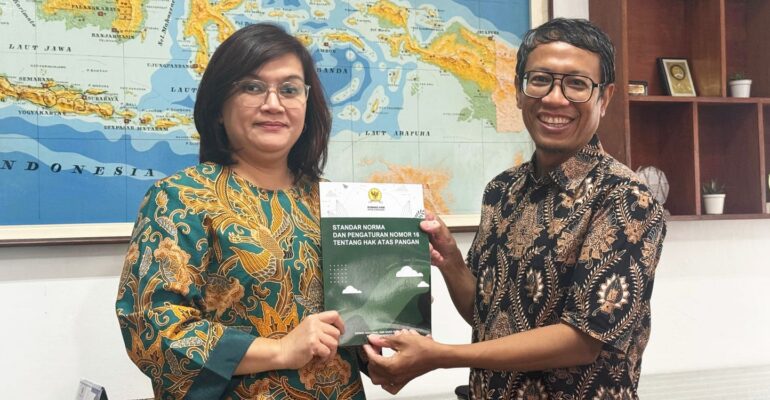
Amidst the intensification of the Free Nutritious Meals (MBG) program and the Food Estate project, the National Human Rights Commission (Komnas HAM) together with the Center for Agricultural and Rural Development Studies (PSP3) IPB University held an important discussion at the Baranangsiang Campus, Bogor.
This discussion served as a forum to socialize Standard Norms and Regulations (SNP) Number 16 on the Right to Food, which was recently issued by Komnas HAM. One key message emerged: food is not merely a commodity or social assistance, but a human right inherent to every individual to live with dignity.
Komnas HAM Commissioner Atnike Nova Sigiro explained that SNP No 16 was drafted to fill the void of comprehensive legal guidance on the right to food. This document serves as an “official interpretation” that is morally binding on the state in implementing food policy, as well as a guide for non-state actors, including the private sector and civil society, in respecting and fulfilling the food rights of citizens.
The most fundamental point of the SNP is a shift in perspective. Komnas HAM policy analyst Delsy Nike emphasized that food security has often been measured solely in terms of the absence of hunger.
“SNP No 16 demands a higher standard, namely the fulfillment of the Right to Adequate Food,” she said. According to the SNP document, adequate food includes four pillars: availability based on sustainable production (not imports), economic and physical affordability (prices and goods are easily accessible even in remote areas), nutritional adequacy and cultural acceptance, and environmental sustainability (not destructive).
During the discussion session, the Chair of the Sustainable Rural Development Division at PSP3 IPB University, Mohamad Shohibuddin, used SNP No. 16 as an analytical tool to review the Food Estate and MBG policies. He warned that large-scale food projects have the potential to ignore the rights of indigenous peoples and ecological sustainability.
“Converting forests and sago swamps into rice fields is not just a technical issue, but a form of food violence that uproots the culture of the Marind Anim community,” he asserted.
He also highlighted the militaristic approach in national food policy through the involvement of support battalions. Instead of empowering, this risks creating a climate of intimidation and closing the space for participatory civil dialogue in national food governance.
According to Shohibuddin, this large-scale monoculture food production model is actually trapped in a vortex of corporate capture. A handful of elites and giant industries are the ones who benefit the most compared to small food producers.
“Without transparency and good governance, this militaristic giant project is very vulnerable to becoming a venue for rent-seeking, which ultimately sacrifices the human rights of small farmers and environmental sustainability for short-term economic gains,” he emphasized.
Shohibuddin also highlighted the MBG program, which has absorbed a large budget but still faces structural challenges, ranging from accountability gaps, food security risks, regional quality disparities, to the potential for corporate domination that could marginalize local producers.
In closing, the discussion produced several strategic recommendations. Komnas HAM and PSP3 IPB urged that SNP No 16 not only remain a document on paper, but become the main reference in revising the Food Law and auditing national food projects.
Shohibuddin called on the government to decentralize the food system. “Return food sovereignty to regional food systems, village food barns, and family gardens. Not to giant projects that are prone to corruption,” he concluded. (*/Rz) (IAAS/LAN)

