IPB University Patriot Expedition Team Research Reveals Three Leading Commodities in the Kerang Transmigration Area
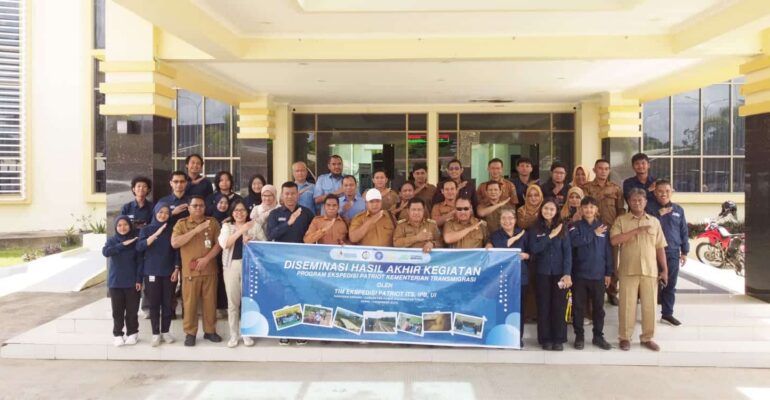
The IPB University Patriot Expedition Team presented the results of its study and mapping of leading commodities in the Kerang Transmigration Area, East Kalimantan. During the meeting, which was held in the Paser Regency Communication and Information Office Meeting Room, the team also formulated recommendations for sustainable regional development.
“What has been produced in today’s research and discussion must become recommendations that can truly be followed up in a sustainable manner,” said Juhaeni, Chairman of the Transmigration Division of Paser Regency.
The research results were compiled through SWOT (strengths, weaknesses, opportunities, threats) analysis, LQ (location quotient), AHP (analytical hierarchy process), supply chain mapping, and financial analysis.
The Chairman of the IPB University Patriot Expedition Team, Dr Doni Sahat Tua Manalu, stated that strengthening agribusiness in the region must begin from upstream to downstream. The availability of seeds, fertilizers, and agricultural machinery (alsintan) is the foundation. Meanwhile, the implementation of good agricultural practices (GAP) and good handling practices (GHP) is necessary to improve quality.
“We also encourage the development of MSMEs and regional processing units, as well as strengthening human resources, institutional capacity, and infrastructure improvements as supporting systems. For the Keladen Transmigration Settlement Unit (UPT), we propose an integrated farming system,” he said.
Representatives from the IPB University team, Laila Azizah Syukur, Putri Nadira Gustina, Izzudin Haidar Al Qossam, and Farhan Fauzul Azhim presented the results of their mapping of leading commodities. There are three main commodities that have strong prospects for development. Namely, oil palm (plantation), banana (horticulture), and corn (food crops).
Oil palm is the commodity with the largest contribution, covering an area of 200.000 hectares or 92 percent of the existing plantation land. “However, there are still weaknesses, ranging from production quality that does not meet national standards, low productivity of smallholder plantations, to limited capital, especially in the first three years of cultivation,” said Putri.
Corn is a pillar of regional food security. “The strength of corn can be seen from the contribution of Batu Engau Subdistrict, which accounts for 91 percent of Paser Regency’s production. Corn is a raw material for poultry feed, which is in high demand. In addition, it is relatively easy to process,” said Izzu.
In horticultural commodities, Farhan revealed that bananas have the potential to become an icon of the region. “Banana cultivation is relatively easy, the capital turnover is fast, and the government has a program to strengthen horticulture through Paser Berbuah.”
The results of this dissemination are an important basis for the local government in formulating the direction of development policies in the Kerang Transmigration Area. Through collaboration across various sectors and institutional strengthening, it is hoped that the Kerang Transmigration Area can develop more productively, sustainably, and improve the welfare of the community. (*/Rz)(IAAS/RWA)