From Japan, New Rector of IPB University Promotes Agromaritime 5.0 Agenda for Innovative Solutions to Global Food and Climate Issues
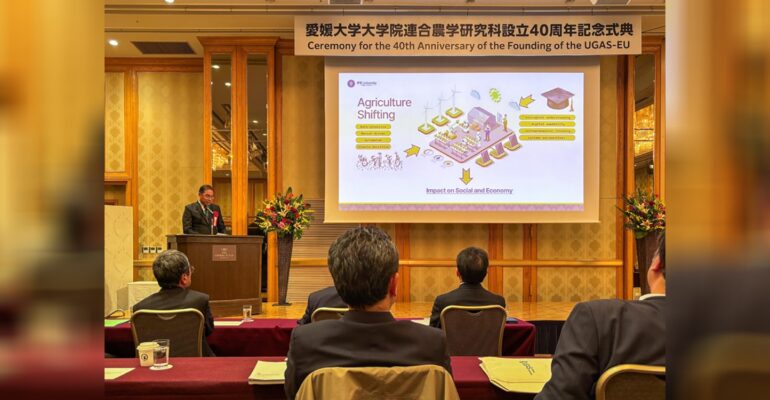
A day after being elected as IPB University’s Interim Rector (PAW) for the 2025–2028 term, Dr Alim Setiawan immediately departed for Japan to attend the 40th anniversary of the United Graduate School of Agricultural Sciences (UGAS), Ehime University (12/6).
As an alumnus of UGAS from 2014 to 2017, Dr Alim was invited to give a commemorative lecture on his experiences and views on transformative leadership in the field of Agricultural Sciences.
In his presentation, Rector Alim explained that the three pillars of higher education (education, research, and community service) have now been expanded with a fourth pillar, namely innovation for social impact.
“Higher education institutions are not only tasked with educating and conducting research, but also with producing technology and policy recommendations that strengthen national development and resilience,” he explained.
He emphasized, “IPB University is currently moving towards the Agromaritime 5.0 era, a framework that places humans, sustainability, and resilience at the center of innovation.”
He mentioned technologies such as artificial intelligence (AI), the internet of things (IoT), big data, blockchain, and brain-computer interfaces as levers for community welfare, especially for farmers and fishermen.
The rector also outlined the three pillars of science that now form IPB University’s research ecosystem in the agromaritime field, namely AI, omics science, and sustainability science. These three pillars are linked by social sciences, which play a role in bridging technological innovation with community dynamics through studies of behavior, ethics, governance, and public policy.
Global demand for AI-based capabilities is increasing. At the same time, many conventional methods are being abandoned. “To prepare future talent, IPB University is strengthening the competencies of students and researchers in AI, digital skills, and green skills,” he said.
At the end of the session, Dr Alim emphasized that food security, climate change, and digital transformation are shared challenges that require cross-border collaboration. IPB University, he said, continues to be open to working with various partners to produce inclusive and sustainable impacts. (*/Rz) (IAAS/ASY)