Origin of the Logwood Found at the North Sumatra Landslide Site: IPB University Expert Explains
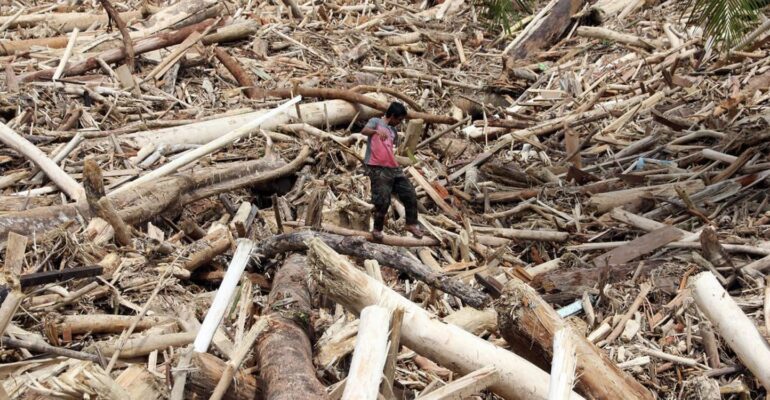
IPB University forest policy expert, Prof Dodik Ridho Nurochmat, provided clarification regarding the discovery of logs swept away by the landslide and floods in South Tapanuli and Central Tapanuli, North Sumatra. He delivered this explanation during a national television program in Jakarta, Sunday (11/30).
According to Prof Dodik, the presence of both large and small logs scattered across the affected area does not stem from a single source. Based on visual information circulating on social media and television, he assessed that the logs likely came from a mix of harvesting activities, fallen trees, and unremoved land-clearing residues.
“They could come from old logging activities or incomplete land clearing. When carried by water flow, the logs will float. But they may also come from recent logging. Therefore, an investigation is needed,” he said.
He stated that it remains uncertain whether all the logs are newly cut timber or older wood carried downstream. The high water discharge during the landslide, he added, could have uprooted trees, adding more woody debris into the area.
Prof Dodik also explained the difference between illegally logged wood and naturally fallen timber. Cut logs will show clear saw marks, whereas naturally fallen trees do not have neat cutting patterns. However, he noted that it is difficult to identify such details solely from videos or photos.
“The footage shows logs of various sizes. But it is not possible to examine in detail whether the cuts are clean or the result of natural treefall,” he said. He emphasized the need to improve environmental governance to prevent similar disasters in the future.
Regarding the cause of the landslide, Prof Dodik said it resulted from a combination of natural and human factors. “There are extreme weather conditions, mountainous geography, and environmental degradation caused by human activities,” he explained.
He highlighted the importance of complying with regulations such as Environmental Impact Assessment (AMDAL), Strategic Environmental Assessment (KLHS), and law enforcement that focuses not only on penalties but also on environmental recovery.
Discussing forest loss in northern Sumatra, Prof Dodik clarified that forest loss includes degradation, while deforestation has a specific legal definition. “In Indonesia, the threshold is 30 percent. If forest cover drops below that number, deforestation is considered to have occurred,” he said.
He warned that reduced forest cover threatens environmental carrying capacity.
Prof Dodik concluded by underscoring the importance of forest multifunctionality and sustainable forest utilization. “Communities should be able to benefit from forests without destroying them,” he said. (IAAS/MRM)