LRI i-MAR IPB University Collaborates with Students and Fishermen to Hold a Campaign for Sustainable Belangkas: Save Mimi, Save the Coast
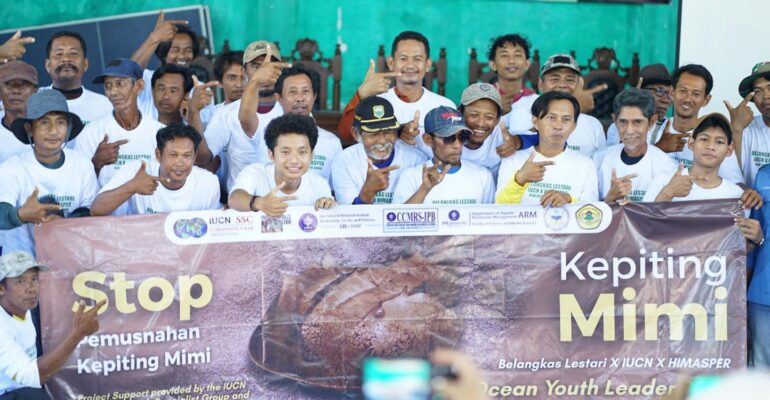
Like living fossils that swim, mimi crabs or horseshoe crabs have inhabited the earth for hundreds of millions of years. However, the existence of this ancient biota is now threatened in the coastal waters of Subang.
In response to this challenge, the International Research Institute for Maritime Affairs, Marine Sciences, and Fisheries (LRI i-MAR) together with the IPB University Water Resources Management Student Association (Himasper) held an event called “Belangkas Lestari: Save Mimi, Save the Coast”.
Funded by the IUCN Horseshoe Crab Specialist Group and the Indianapolis Zoological Society, Inc, the event took place in the villages of Mayangan and Legon Wetan, Subang Regency.
The threat to the horseshoe crab population is real. Intensive fishing activities using non-selective fishing gear have led to high bycatch rates.
This fact is reinforced by data from the International Union for Conservation of Nature (IUCN), which lists several mimi species as vulnerable to near threatened. In fact, their role in the food chain and coastal ecosystem balance is vital.
“Belangkas Lestari is a concrete response. For two days, a team consisting of students, academics, and conservation practitioners went directly to the heart of the problem.
Various educational activities were held, ranging from door-to-door campaigns to engage fishermen in dialogue, conservation outreach programs in coastal schools to instill awareness from an early age, to workshops teaching the manufacture and use of environmentally friendly fishing gear.
This long-term commitment was marked by the installation of conservation signs at two points along the Legonkulon coastline. These signs are not mere symbols, but visual reminders of a shared commitment to protect the natural habitat of this living fossil.
Lusita Meilana, Project Leader of Belangkas Lestari, emphasizes the importance of a collaborative approach to conservation. “Through ‘Belangkas Lestari’, we not only want to save the precious population of horseshoe crabs, but also strengthen the resilience of the coastal ecosystem as a whole.”
“The support from the IUCN Horseshoe Crab Specialist Group and the Indianapolis Zoo is clear evidence of global concern, while the active participation of the community and local fishermen is key to the sustainability of these conservation efforts. We believe that by combining science, policy, and local wisdom, we can create harmony between the coastal economy and nature conservation,” she explained.
In line with this, Nizar Rifan Khairiansyah, Executive Chair of the activity from Himasper IPB University, emphasized that this initiative is a tangible contribution from students.
“We hope that ‘Belangkas Lestari’ can foster sustainable community awareness of the preservation of mimi and coastal ecosystems that support their livelihoods,” he said.
This multidisciplinary collaboration is not merely ceremonial, but a strategic step in building community-based conservation. Through this concrete action, LRI i-MAR and Himasper IPB University demonstrate their dedication to preserving Indonesia’s natural heritage for future generations. (*/Rz) (IAAS/KQA)