Patriot Expedition Team in Kerang, East Kalimantan Presents Results of Identification and Mapping of Local Leading Commodities
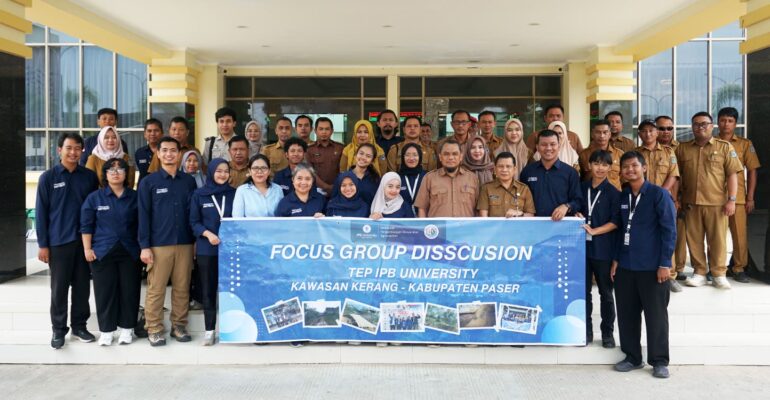
The Patriot Expedition Team held a focus group discussion (FGD) at the Meeting Room of the Communication and Information Agency (Diskominfo) of Paser Regency, East Kalimantan.
This FGD served as a forum for research teams from three universities, IPB University, University of Indonesia, and Sepuluh Nopember Institute of Technology, to present their preliminary findings and confirm and classify research data in the Kerang Transmigration Area.
Rizky Noviar, SSTP, Chairman of the Manpower and Transmigration Office (Disnakertrans) of Paser Regency, explained that land issues remain a crucial point in the development of transmigration areas.
“The Patriot Expedition is expected to help develop the transmigration area in Paser Regency,” he said.
Lailah Azizah Syukur, a representative of the IPB University team, said that plantation commodities in the Kerang Transmigration Area are dominated by oil palm (92%), rubber (7%), and coconut (1%). “Oil palm is the most popular because the price is guaranteed, there is a market for it, and it is supported by large companies,” she said.
In addition, horticultural commodities that thrive in the area are dominated by bananas. Meanwhile, the leading food commodities in the three subdistricts include rice, corn, peanuts, and cassava.
“However, there are still various obstacles, such as limited water sources, damaged roads, and inadequate land cultivation facilities,” said Lailah.
During the FGD, various parties provided input. The Tanjung Harapan sub-district highlighted the need for training for transmigrants, not all of whom have an agricultural background, as well as the importance of adapting seeds to local soil conditions.
Several villages also conveyed their conditions and input. One of them was a representative from Riwang Village, who hoped for the development of a market for food crops other than palm oil, such as corn, cassava, taro, chili, and rice.
Responding to this, Dr Doni Sahat Tua Manalu, representing the team from IPB University, conveyed the need for multisectoral involvement to support the successful development of leading commodities in the Kerang area.
“The hope is that these recommendations can bring significant changes to the transmigration settlement units (UPT) and surrounding villages,” continued the lecturer from the Agribusiness Management Study Program at IPB University’s Vocational School.
The IPB University team also emphasized the importance of synchronizing secondary data and field findings, as well as encouraging supporting villages to participate in providing input on potential commodities.
Supporting villages, he said, play a significant role in the development of the Keladen transmigration area, especially in terms of the supply chain directly related to the production and marketing of leading commodities.
Representatives from ATR/BPN, Bappeda Litbang, the Food Crops Agency, the Public Works Agency, Tanjung Harapan Subdistrict, Pasir Belengkong Subdistrict, as well as representatives from transmigration villages and supporting villages were also present at this event. (*/Rz) (IAAS/FMT)