More than 468 Thousand Lizards Exported, IPB University Professor Reminds Conservation Aspects
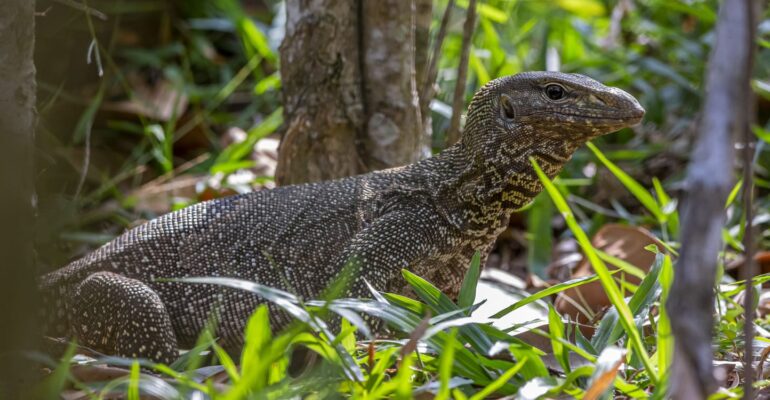
Indonesia is one of the largest exporters of monitor lizard skins in the world with a quota of hundreds of thousands per year. Prof Mirza Dikari Kusrini, Professor of the Faculty of Forestry and Environment of IPB University emphasized the need for science-based governance so that this trade remains safe without damaging the ecosystem.
Based on the quota book of the Ministry of Environment and Forestry (KLHK) for 2024, a total of 476.000 monitor lizards can be traded.
A total of 468.560 of them are specifically for skin export needs. The quota is spread across 18 provinces, with North Sumatra as the largest quota recipient.
Besides for export, monitor lizards are also hunted at the local level. Prof Mirza said, “Research by IPB University students shows that monitor lizards are used for meat consumption and traditional medicine. This animal is also often considered a pest in some areas.”
“In West Java, there is a group of monitor lizard hunters who use dogs to catch them, both for sale and consumption,” said Prof Mirza who is also a lecturer in Forest Resource Conservation and Ecotourism (KSHE) IPB University.
Prof Mirza explained that monitor lizards (Varanus spp.), especially water monitor lizards (Varanus salvator), are opportunistic predators as well as carrion eaters.
“Lizards play a very important role in the food chain, from preying on fish, small reptiles, birds, to small mammals. They also help as population control and serve as natural environmental cleaners,” he explains.
However, he emphasized that monitor lizard interactions with humans often change with the decline of natural predators or the abundance of food around settlements.
“In some neighborhoods, monitor lizards even prey on kittens. We have studied this phenomenon in urban areas,” he added.
According to him, the monitor lizard trade in Indonesia is still within safe limits. In terms of regulations, water monitor lizards are not protected animals, according to the Minister of Environment and Forestry Regulation P.106/2018. However, its international trade is controlled through the CITES Appendix II mechanism.
“This means that water monitor lizard trade is allowed under the condition that there are quotas, export permits, and non-detriment findings (NDF) studies,” said Prof Mirza.
Prof Mirza emphasized that although the status of monitor lizards on the International Union for Conservation of Nature (IUCN) Red List is still ‘Least Concern’, the government still needs to maintain a balance between economic use and conservation. Strict supervision and science-based policies are important so as not to impact the sustainability of the ecosystem.
“Quotas must be science-based, export suppliers must be legal and have traceability, and local hunters must get a fair price. That is the key to making the monitor lizard trade sustainable,” he concluded. (dr) (IAAS/LAN)