Realizing Independence for Elderly Care Homes, IPB University PKM Team Presents ‘Pelita Swakarsa’
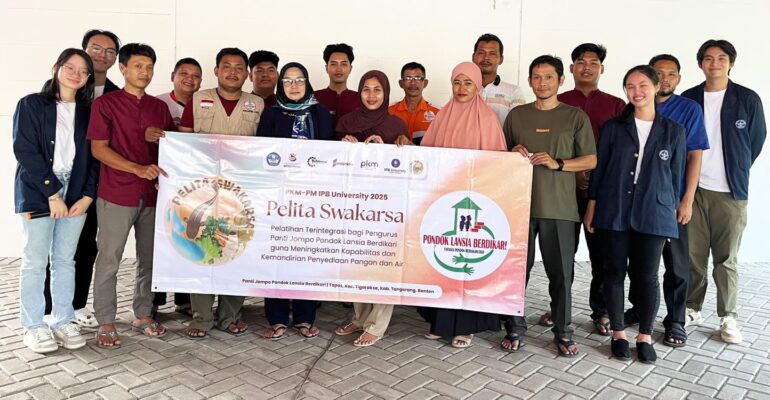
Four IPB University students initiated the Pelita Swakarsa program for the management of the Pondok Lansia Berdikari (PJPLB) Elderly Care Home. This program aims to foster food self-sufficiency and clean water management through an educational, sustainable, and participatory approach.
Pelita Swakarsa is a training program initiated by four IPB University students, namely Agatha Valencia, Rowen Aristo, Grisela Novinta, and Wilman Fazar Nugraha.
This program was born out of concern over the limited availability of food and the challenges of meeting clean water needs at PJPLB. Through the Student Creativity Program for Community Service (PKM-PM), they sought to provide solutions based on appropriate technology and community empowerment.
The PKM team leader, Agatha Valencia, explained that the name Pelita Swakarsa is not just a label. More than that, it has a deep meaning.
“Pelita symbolizes light that illuminates the path, while Swakarsa means independence. Through this name, we want to bring light that fosters independence for orphanage administrators in managing their daily needs,” she said.
This program has three main subprograms, namely GoldieGrow, EcoCycle, and ReAqua. GoldieGrow presents an aquaponics system as a solution for food self-sufficiency, EcoCycle develops maggot cultivation for organic waste management, while ReAqua focuses on recycling laundry water so that it can be reused.
The three subprograms are organized within a single sustainability framework and implemented in stages according to the readiness of each orphanage. Agatha said that Pelita Swakarsa applies the Technical and Vocational Education and Training (TVET) method combined with the 5S principles (Seiri, Seiton, Seiso, Seiketsu, and Shitsuke).
“This approach ensures that training does not stop at theory, but is immediately applied together with the orphanage administrators. The 5S principle fosters regular and disciplined work habits, making it easier for administrators to consistently adopt new skills,” she said.
Since its implementation, the program has shown tangible results. The aquaponics system in the GoldieGrow subprogram is now operational and undergoing routine maintenance. Meanwhile, EcoCycle has successfully harvested maggots, which are directly used as feed for catfish in the aquaponics system. The synergy between the two programs is proof of Pelita Swakarsa’s initial success in providing sustainable solutions in orphanage environments.
“The main strength of this program lies in the collaboration and integration between subprograms. Administrators who were initially hesitant are now becoming accustomed to managing the system and feel a sense of ownership over the results. The routine monitoring process has also boosted their confidence in implementing this simple technology,” said Agatha. (**/dr) (IAAS/NRA)