Caring for AMPK, IPB University Student Team Initiates Bright Canvas
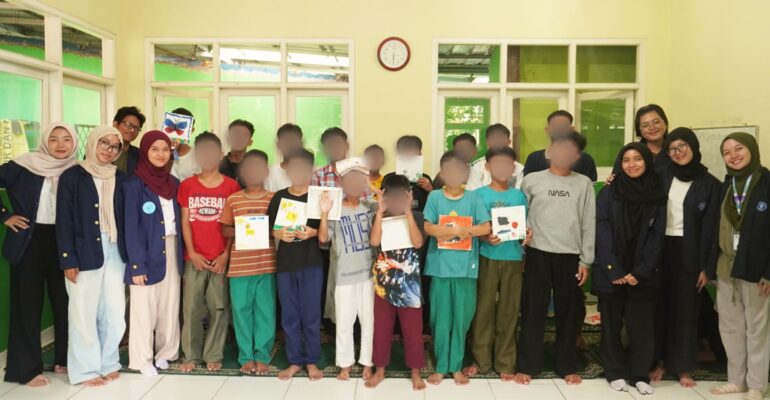
The IPB University student team has once again demonstrated its social awareness, particularly towards children who require special protection (AMPK). Through the Bright Canvas program, students help these children to express themselves more easily through art.
“Many of them have difficulty channeling their emotions and expressing themselves. We see art and spatial approaches as a safe medium for expression while also training fine motor skills,” said Rajwa Mutiara Fauziyyah Farni, one of the student representatives.
The program targets children with traumatic backgrounds who are often marginalized. The team uses Kolb’s Experiential Learning approach through four phases: experience, reflection, concept, and practice.
“So, the children don’t just draw or create works of art, but are also invited to reflect on the meaning of their work and recognize their emotions,” explained the student from the IPB University School of Business.
The main activity of Bright Canvas is spatial-based art exploration combined with self-reflection, such as drawing safe spaces, creating emotion maps, and simple miniatures. Each work is then discussed with a mentor to connect nonverbal expressions with verbal understanding.
This activity is part of the Student Creativity Program in the field of Community Service (PKM-PM) initiated by Rajwa and her four colleagues. They are Atha Nabilah Rosyadi (Statistics and Data Science), Bimo Wibisono (Agricultural Engineering), Rafinda Mutiara Putri (Communication and Community Development), and Zaidan Putra Alip (Development Economics), and are supervised by Hana Indriana SP, MSi, a lecturer at the Faculty of Human Ecology, IPB University.
However, Rajwa acknowledged that there were major challenges in developing the curriculum and activity benchmarks. “We had to create simple activities that could be accepted by all ages but still have an impact. Children with trauma also need a long time to trust, so a personal approach is very important,” she said.
For sustainability, the team prepared modules based on Kolb’s theory and spatial art that could be used by orphanage caregivers. They also strive to expand the impact through pentahelix collaboration with the government, media, academics, communities, and businesses.
“Our hope is simple: that every child feels the change from the small Bright Canvas movement. For us, we hope this becomes a learning process and the beginning of broader contributions in the social and community development fields,” concluded Rajwa. (Fj) (IAAS/RMH)