Getting to Know the Unique Concept of a Low-Carbon Floating Market An Idea from IPB Students, Using Bamboo Coins for Transactions
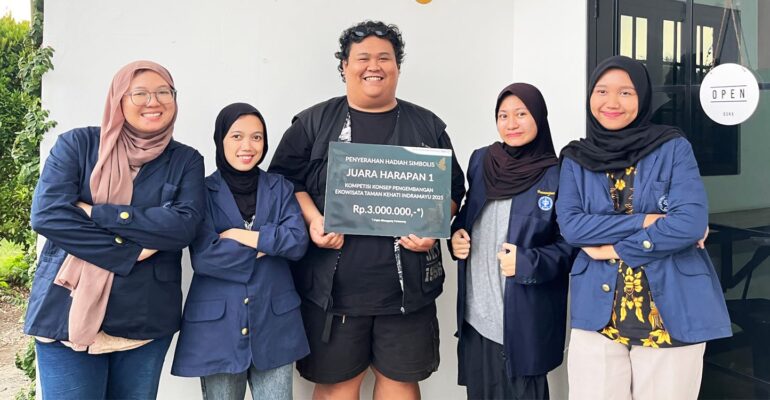
Five graduate students from IPB University’s Tropical Biodiversity Conservation (KVT) program developed an eco-tourism concept for the Indramayu Kehati Park that is low-carbon, environmentally friendly, educational, and participatory.
One of the interesting concepts offered is the “floating market.” This concept is designed to boost the local economy by strengthening micro, small, and medium enterprises (MSMEs) in the Rawa Gelam area, Indramayu, West Java.
One of the students, Aji Zahwan Alim, S.Hut, explained that the uniqueness of the floating market concept lies in the use of canoes as a medium for buying and selling, which is different from traditional land-based markets.
This floating market serves as a means of strengthening the role of local MSMEs in supporting sustainable ecotourism. Through this market, MSMEs are given the opportunity to promote and sell various environmentally friendly products, such as non-timber forest products (NTFPs), natural fertilizers, hydroponics, handicrafts, and local foods.
“The products traded in the floating market come from local MSMEs that have been curated to be in line with the principles of sustainable ecotourism. In addition, the floating market is not only a place for economic transactions, but also a tourist attraction, an environmental education center, and a center for the preservation of local culture. This is what makes it different from other traditional markets,” said Zahwan (9/22).
Zahwan further revealed a number of environmentally friendly and low-carbon strategies in this floating market. A zero waste policy is implemented by prohibiting the use of single-use plastics, encouraging the use of natural containers, and properly managing organic waste.
“Transactions are carried out using HHBK-based bamboo coins as a substitute for conventional money. Apart from being more environmentally friendly, this method also provides a unique experience for visitors,” he explained.
Additionally, water quality in the floating market area is maintained through a natural filtration system or simple ecohydrology. Mobility in the tourist area is also directed toward walking or using non-motorized boats to reduce carbon emissions.
“Supporting infrastructure is also built using environmentally friendly materials such as bamboo and recycled wood, so this floating market truly reflects the concept of low-carbon tourism,” he said.
“Entrance tickets are no longer made of paper, but have been replaced with an environmentally friendly stamp system to reduce printing waste,” added Zahwan.
The floating market concept initiated by Zahwan and his friends was submitted to a competition held by PT Polytama Propindo. In the competition, Zahwan’s team won first runner-up.
In addition to the floating market, the eco-tourism development concept he initiated at Taman Kehati Indramayu also consists of four other main zones, namely the conservation education zone, transportation and circulation zone, rest and interpretation zone, and demonstration and eco-cracration zone. In each zone, the planning is focused on low-carbon and sustainable principles. (MHT) (IAAS/FMT)