Responding to the Demonstration Phenomenon, IPB Strategic Talk Emphasizes the Urgency of People’s Aspirations in Economic Policy
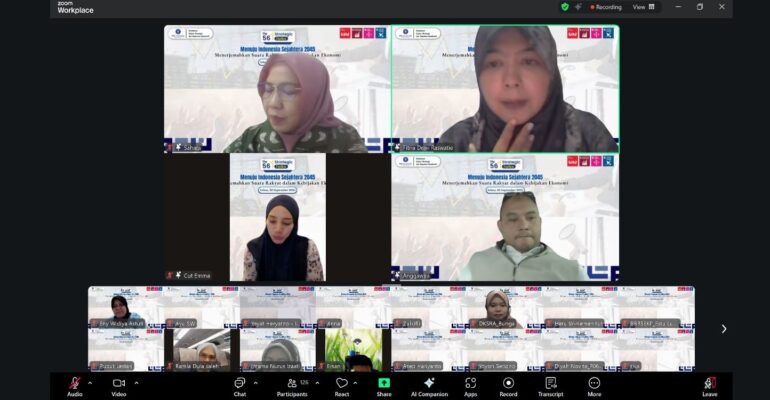
The recent wave of demonstrations has further emphasized the urgency of formulating solutions based on the real needs of the community. Responding to this phenomenon, IPB University held the 56th IPB Strategic Talk entitled “Towards a Prosperous Indonesia in 2045: Translating the Voice of the People into Economic Policy” (9/23).
Prof Ernan Rustiadi, Vice Rector of IPB University for Research, Innovation, and Agromaritime Development, said in his speech that the vision of the 2045 Long-Term Development Plan (RPJPN) is to make Indonesia a high-income country. However, various social unrest and public demands indicate that there are still problems and challenges in various sectors.
“From the outset, IPB University has been studying several demands, particularly regarding the Job Creation Law—one of the points of public demand—which is considered biased towards the interests of entrepreneurs and the central government, while the aspect of job creation for the community is still neglected,” he said.
One of the speakers, Professor Sahara from the Faculty of Economics and Management at IPB University, presented data on the analysis of Indonesia’s economic transformation, which shows a decline in the contribution of the agricultural sector to the gross domestic product (GDP) from 24 percent in 1982 to 12,4 percent in 2023. On the other hand, the contribution of labor in this sector remains high, at 28 percent.
“The 8 percent economic growth target requires acceleration in agriculture, manufacturing, and services. To that end, rural industrialization and skills improvement programs are important to drive inclusive growth,” she explained.
She also emphasized the integration of the agricultural sector with industry and services through technological innovation, human resource development, infrastructure, and access to financing.
Furthermore, Prof Sahara emphasized the importance of sustainable agricultural practices and effective policy communication to the public, including the use of digital platforms to strengthen community participation in economic development.
The Secretary General of the Central Executive Board of the Indonesian Young Entrepreneurs Association (HIPMI), Dr Anggawira, also highlighted issues surrounding political representation, economic transformation, and governance.
She said that the current political system does not sufficiently accommodate the voice of the people, especially through electoral reform and term limits for legislators. Without substantial improvements in education, human resources, and economic policy, Indonesia’s development goals will remain difficult to achieve.
“For example, in initiative programs such as Free Nutritious Meals and the Merah Putih Cooperative, there is a lot of potential for predators to exploit these programs. Therefore, proper implementation and supervision are necessary. IPB, as a campus that focuses on agrosociopreneurship, can play an important role in this regard.”
Also present was Cut Emma Mutia Ratna Dewi (Advisor for Small and Medium Enterprise (SME) Business Development), who highlighted the importance of sustainable natural resource management and human resource development for Indonesia’s economic progress.
As a conclusion, Fitria Dewi Raswatie, SP, MSi, as the moderator, emphasized that the voice of the people is an important foundation for the creation of fair, inclusive, and sustainable economic policies. “Public aspirations are not only evaluations but also a shared energy in realizing Indonesia Emas 2045,” she concluded. (*/Rz) (IAAS/KQA)