AWS Community Innovation from IPB University Strengthens Precision Agriculture in Pekalongan and 100 Regions in Indonesia
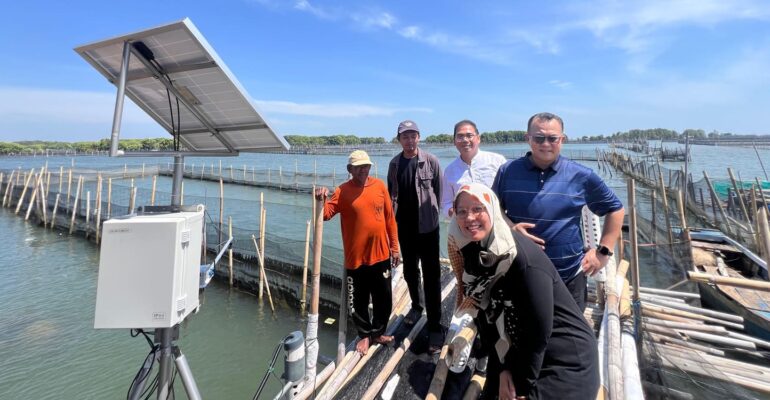
The Rector of IPB University, Prof Arif Satria, directly observed the use of the Community-based Automatic Weather Station (AWS) in Jeruksari Village, Pekalongan Regency, Central Java, on Sunday (9/28).
The results of this innovation by the IPB University research team (Dr Idung Risdiyanto, Prof Suryo Wiyono, and Dr Akhmad Faqih) have proven to help pond farmers cultivate their crops with precision through information on temperature, water pH, salinity, and weather.
In addition to Pekalongan, the Community AWS has also been implemented in 100 areas in Indonesia spread across the islands of Java, Sumatra, and Bali.
“The Community AWS is not just a measuring device technology, but part of an ecosystem for empowering farming communities so that they are able to make data-based decisions and are more resilient in facing climate change,” explained Prof Arif.
AWS IPB University researcher Dr Idung Risdiyanto explained that each AWS unit automatically records key weather parameters every five minutes.
These parameters include air temperature, rainfall, relative humidity, solar radiation, dew point, air pressure, and wind speed. The collected data is then stored on a cloud-based server and can be accessed online through www.sinoptik.ipb.ac.id, and map.sinaubumi.org portals.
According to Dr Idung, this monitoring platform continues to be developed to expand storage capacity and strengthen service functionality.
“The use of Internet of Things (IoT) technology enables real-time data transmission from various points throughout Indonesia without manual intervention,” he said.
Furthermore, the data collected is not only useful for monitoring, but also used to build location-specific weather prediction models using machine learning and IoT approaches.
This system, said Dr Idung, is capable of producing short-term weather forecasts that are very useful for farmers.
“This analysis supports more precise and adaptive planning of planting, harvesting, fertilizing, pest control, and crop management,” he added.
The impact of this technology is also felt by the people of Jeruksari Village. H Budi Harto, Head of Jeruksari Village, said, “Now Jeruksari Village has become modern with tools like this. The community no longer needs to bother looking for rain information; they can simply visit the Village Hall to ask about weather conditions. It’s great, amazing.” (**/dr) (IAAS/FMT)