Sensitive plant Has Great Potential, IPB University Expert Reveals Active Compounds
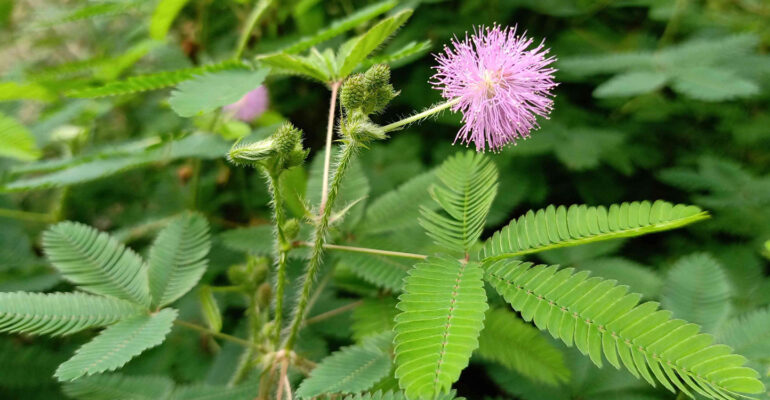
The shy sensitive plant (Mimosa pudica), often considered a weed, has great potential as a source of bioactive compounds for the pharmaceutical and cosmetics industries.
Dr Trivadila, a lecturer at the Department of Chemistry and a Researcher at the Center for Tropical Bioactive Compounds Studies at IPB University, revealed that the active compounds found in the leaves, stems, and roots of this plant have a wide range of benefits, including antibacterial, anticancer, and antioxidant properties.
“The sensitive plant contains various secondary metabolites such as alkaloids, saponins, terpenoids, flavonoids, and coumarins,” she explained.
The leaves and stems contain flavonoids such as isoquercitrin, avicularin, apigenin-7-O-D-glycoside, cassiaoccidentalin B, orientin, and isoorientin. In addition, there are important minerals such as magnesium, phosphorus, calcium, nitrogen, and potassium.
Furthermore, Dr Trivadila explained that mimosa pudica leaves also contain carotenoid compounds, including neoxanthin, violaxanthin, lutein, lycopene, and carotene, as well as tocopherol, which acts as a natural antioxidant.
Other unique compounds are mimopudine, which triggers the leaf opening mechanism, and turgorin, which affects the movement of closing the leaves when touched.
“In the roots, fatty acids, proteins, sterols, alkaloids, tannins, terpenoids, flavonoids, and phenolic compounds were also found,” she added.
Other compounds include 2-hydroxymethyl-chroman-4-one and betulinic acid. All parts of the plant also contain the non-protein amino acid L-mimosine, as well as the hormones jasmonic acid and abscisic acid, which play a role in plant development and stress response.
Dr Trivadila explained that the potential for utilizing these compounds is wide open, especially in the pharmaceutical and cosmetic industries.
“Extracts and compounds from putri malu have antibacterial, antifungal, antiviral, anticancer, antidiabetic, antioxidant, and antidepressant activities,” she said.
L-mimosine, for example, has been reported to have promising cytotoxic activity for cancer therapy, while the compound 2-hydroxymethyl-chroman-4-one exhibits antifungal activity.
Despite its great potential, the extraction and purification of active compounds from putri malu face several challenges. Extraction yields are often low, especially when the compounds are found in the root portion, which has a small volume. Additionally, standardizing the content of active compounds requires special cultivation practices.
“Secondary metabolites are typically produced by plants in response to environmental stress. Suboptimal cultivation can reduce or even eliminate these active compounds,” said Dr Trivadila. (dr) (IAAS/STD)