
PSP3 IPB University and City Government Formulate Solutions to Waste Problems in Pekalongan
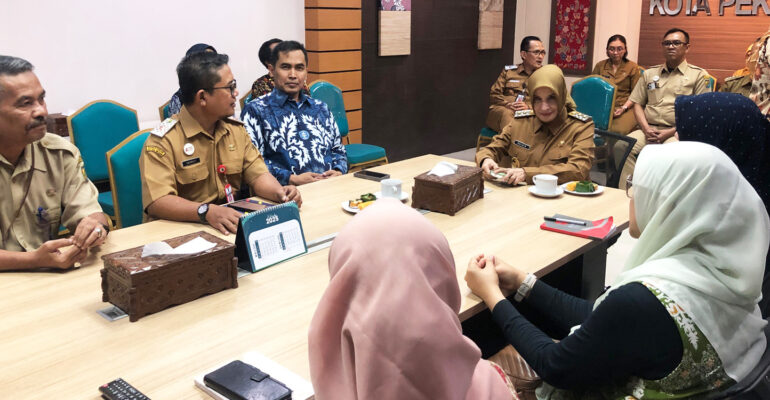
The Center for Agricultural and Rural Development Studies (PSP3) of IPB University together with the Pekalongan City Government (Pemkot) are formulating strategic solutions in overcoming the complex problem of waste management in Pekalongan City.
In a focus group discussion (FGD) that took place at the Pekalongan Mayor’s Office (6/4), Hj Balgis Diab, SAg MM as Vice Mayor stated that the presence of the PSP3 IPB University team was a moment that brought new hope.
“The arrival of the IPB team provides blessings and benefits for us. I welcome it with pleasure. IPB’s experience in waste management can certainly provide inspiration and good practices that we can learn from,” said Hj Balgis.
“Perhaps with PSP3 a new approach will emerge that we don’t find elsewhere. We hope this assistance can be sustainable,” she said again.
Chief of PSP3 IPB University, Prof Jaenal Effendi, explained that PSP3 has extensive experience in assisting innovative waste management programs, including cooperation with companies that exchange plastic waste into money through a digital system.
“We have a team of environmental experts who can contribute significantly. In addition, IPB University also has Thematic Real Work Lecture (KKN) and ‘Dosen Pulang Kampung’ programs that can be synergized with the needs of Pekalongan City,” he explained.
He also emphasized the importance of policies and regulations as the foundation for solving waste management problems in a systemic and sustainable manner.
The FGD revealed a number of major waste management problems in Pekalongan City. Low public literacy about hazardous waste, the absence of local destruction facilities, and the closure of Degayu landfill since March 2025 due to environmental pollution are the main problems faced by this city.
The condition is exacerbated by the limited capacity of human resources (HR) for waste management and an ineffective processing system. Of the 21 available reduce, reuse, recycle (TPS3R) waste processing units, only four are actively operating. As a result, people are confused about disposing of waste, while recycling and organic processing solutions are still not optimal.
“Through this FGD, we agreed to encourage the birth of an integrated and ecoregion-based waste management roadmap, strengthen the capacity of local human resources, build partnerships with offtakers and business actors, and increase the role of communities and academics,” said Prof Jaenal.
He reiterated that innovative, regulative, and participatory approaches are key for Pekalongan City to realize a sustainable waste management system that is adaptive to the social dynamics of society.
This forum presented regional leaders and representatives from various technical agencies. From the PSP3 IPB University, Rizma Ilfi, MIKom; Dr Maya Dewi Dyah M Maharini; as well as other experts and researchers. (*/Rz) (IAAS/LAN)

