IPB University Reveals Indonesia’s Biotechnology Potential: From High-Yield Rice to Sumatran Rhino Conservation
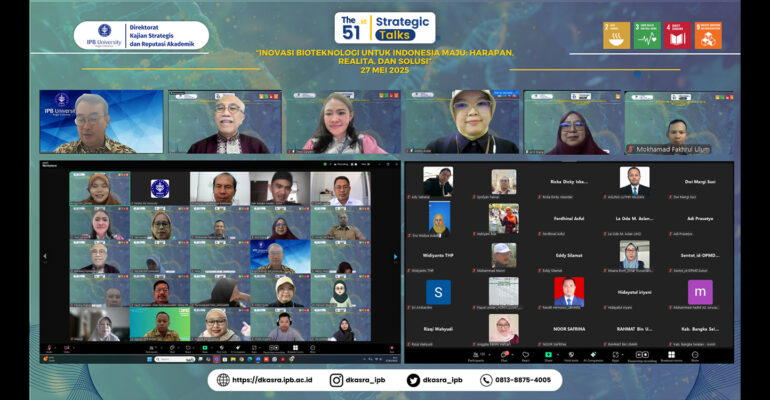
Indonesia has a golden opportunity to leverage its megabiodiversity to become a major player in global biotechnology innovation. This was revealed in the webinar The 51st IPB Strategic Talks titled “Biotechnology Innovation for a Progressive Indonesia: Hope, Reality, and Solutions,” organized by IPB University online (5/27).
Prof Ernan Rustiadi, Vice Rector for Research, Innovation, and Agromaritime Development at IPB University, emphasized the urgency of optimizing Indonesia’s biological wealth for future resilience.
“Indonesia’s megabiodiversity needs to be optimally utilized for biotechnology development. This is so that the country can be resilient in facing the complex challenges of the present and the future,” he said.
He stated that IPB University itself has a high concern for the development and innovation of biotechnology. This commitment is evidenced by the launch of four new rice varieties.
“IPB University has recently launched several new rice varieties, namely IPB 12S, IPB 13S, IPB 14S, and IPB 15S, which have high productivity and climate resilience,” he added.
Biotechnology for Animal Reproduction
Prof Bambang Purwantara, one of the professors at the School of Veterinary Medicine and Biomedical Sciences (SKHB) at IPB University, presented the developments in animal reproduction biotechnology, ranging from artificial insemination, embryo transfer, to in vitro embryo production.
Through innovative research and approaches such as genomics, proteomics, and metabolomics, Indonesia has developed various animal reproduction technologies, including artificial insemination, embryo transfer, and the selection of superior sires based on fertility biomarkers. These efforts are strengthened by IPB University’s collaboration with various parties, such as the Artificial Insemination Center (BIB) and the Superior Livestock Breeding Center (BPTU).
“We are also collaborating on Sumatran rhino conservation through the Assisted Reproductive Technology (ART) and Biobank schemes with the AZW Berlin and Leipzig Zoo teams in Germany,” added Prof Bambang.
Biotechnology: A Solution to the Climate Crisis
Dr Sintho Wahyuning Ardie, a lecturer at the Faculty of Agriculture, IPB University, highlighted the role of molecular biotechnology in creating a climate-resilient agricultural system, particularly for cereal crops and weeds.
Dr Sintho emphasized that global climate change has caused a decline in agricultural productivity due to abiotic stress and competition with herbicide-resistant weed species.
“Cereal crops such as rice, corn, and wheat contribute more than 60 percent of global food energy, so innovations to enhance their resilience are crucial,” she explained.
Dr Sintho also explained that biotechnology enables researchers to identify the core issues of plants and engineer their gene expression to achieve desired outcomes. (*/Rz) (IAAS/LAN)