IPB University Provides Assistance in Making and Using Bioenzyme Fertilizer for Karangjaya Village Forest Farmers Group
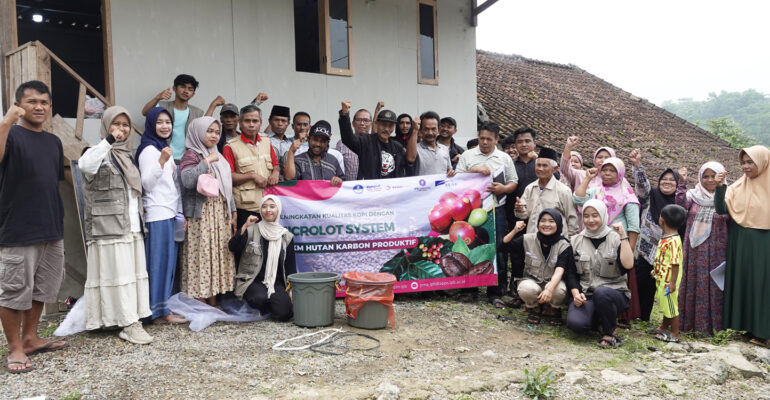
The Directorate of Agromaritime Community Development (DPMA) of IPB University in collaboration with PT Astra International Tbk provided assistance in making and using bioenzyme fertilizers for residents of Karangjaya Village, Pasirkuda District, Cianjur Regency, West Java (16/11).
This assistance is part of the Freedom of Learning – Independence Campus (MBKM) Sociopreneur Productive Carbon Forest program which is run under the Kedaireka 2024 Matching Fund Program (PDP) scheme.
The activity, which was attended by 40 participants from the Forest Farmers Group, presented resource person Ir Wahyu Purwakusuma, MSc, lecturer at the Faculty of Agriculture, IPB University. He explained various important materials, ranging from the principles of organic cultivation, materials and processes for making bioenzyme fertilizers, to effective use techniques. In addition, participants were also directly involved in the practice of making bioenzyme fertilizer and local microorganism fertilizer (MOL).
The main objective of this training was to provide the community with a practical understanding of the utilization of household organic waste into bioenzyme fertilizer, as a solution to improve the quality of crop cultivation. Furthermore, this activity directs participants to plan demonstration plots for coffee and avocado experiments with organic systems, and encourages students involved to improve their competence in community assistance.
“Through this activity, we hope that the community can understand the great benefits of using organic fertilizers. Not only to increase coffee and avocado productivity, but also to maintain the balance of the soil ecosystem in a sustainable manner,” said Ir Wahyu Purwakusuma.
Sukmana, Chief of Karangjaya Village, also expressed his appreciation for this activity. “We are very grateful to IPB University and PT Astra International Tbk for this extraordinary initiative. This training not only provides new knowledge to the community, but also opens up opportunities for our farmers to increase agricultural yields in a more environmentally friendly manner. We hope this kind of cooperation will continue for the welfare of the village community,” he said.
This activity provides various benefits, including increased community knowledge related to organic farming, more environmentally friendly crop cultivation solutions, and the adoption of bioenzyme fertilizer making innovations that are in accordance with Good Agricultural Practices (GAP). With high enthusiasm, the participants showed their enthusiasm in implementing the knowledge gained to improve the quality of farming products while preserving the environment.
This collaboration is a real step in supporting the sustainability of organic-based agriculture in Karangjaya Village, while strengthening the synergy between educational institutions, corporations, and communities to create positive social impact. (*/Rz) (IAAS/RUM)