Desa Sejuta Daun, IPB University Innovation Real-Thematic Work Lecture Student Program Helps Realize an Environmentally Friendly Village
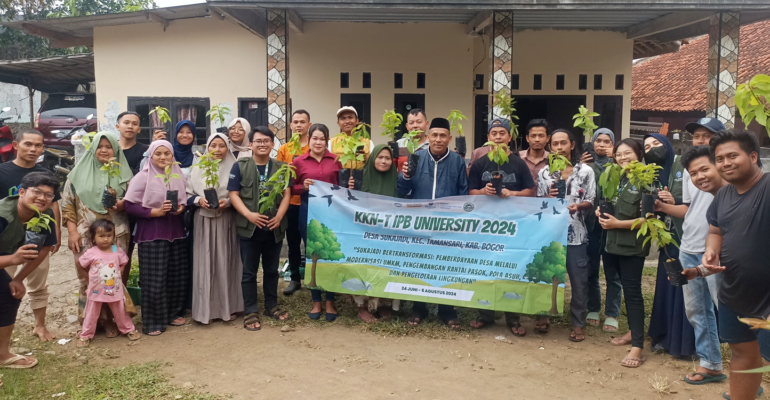
The IPB University Innovation Real-Thematic Work Lecture (KKNT) student team helped the people of Sukajadi Village, Tamansari, Bogor in realizing the Rancage Eco-Village. The action of the IPB University student team was the Desa Sejuta Daun program in the form of planting 1,000 trees in Sukajadi Village (25/7).
Karennia, a student of IPB University hopes that the initiative of this program can be utilized as well as possible by the people of RW 08 Sukajadi Village in order to achieve Rancage Eco-friendly Village again. She explained that the seedlings that have been distributed and planted together can be well cared for and cultivated so that the results can be enjoyed by the community.
The IPB University student explained that the seeds planted consisted of six types, namely avocado, petai, jengkol, soursop, salam, durian and ketapang kencana. “The seeds were taken from Rumpin Nursery, Bogor as many as 1,000 stems consisting of 6 types of seeds, namely 300 avocado seeds, 200 petai seeds, 100 jengkol seeds, 100 soursop seeds, 100 salam seeds, 100 durian lips, and 100 ketapang kencana seeds,” she said.
Karennia said, this tree planting activity also cooperated with the Ciliwung-Cisadane Watershed Management Agency (BPDAS) in providing seeds. In addition, IPB University students also collaborated with environmentally friendly village activists (KRL) and local youth.
KRL Rancage activist Altayani revealed, “KRL Rancage since 2018 has received the title of intermediate level KRL and has become a model for other villages. However, increasingly, public awareness in maintaining the environment is decreasing, this has an impact on the decline in the quality of KRL Rancage.”
One of the Sukajadi Village youths who received tree seedlings, Mulya ND, said that this program has many benefits. “The benefits of the Desa Sejuta Daun program for our village are certainly many. First, it can reduce pollution, second, it can increase the greening of the village environment, and third, the long-term results, if it is fruitful, can be consumed together and can increase the economic field for the community,” he said.
Meanwhile, Saepudin, Head of RT 01/08 appreciated the KKNT Innovation IPB University student program. He said, this activity was very good, even able to improve the progress of farmers and local residents. “If later the trees bear fruit with good results, they can be sold and improve the economy for the village. In addition, there are salam tree seeds that are definitely favored by mothers,” he said. (*/ra/Rz) (IAAS/HRD)