KKNT Innovation IPB University Students Introduce Organic Waste Utilisation Method Using Openwork Bricks
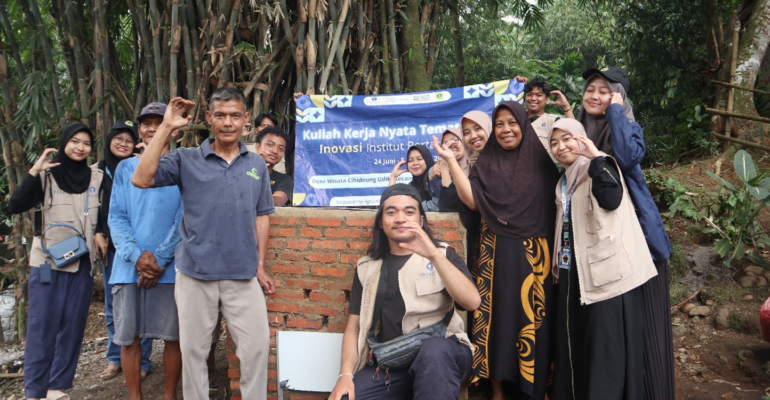
One of the student groups of IPB University’s Innovation Real-Thematic Work Lecture (KKNT) initiated the Cihideung Udik Peduli Sampah (CI-PEDAS) programme in RT 03, RW 012, Cihideung Udik Village, Ciampea District, Bogor Regency, West Java. The programme is aimed at reusing household waste and reducing the proportion and accumulation of organic waste.
According to Azila Gibran, an IPB University student from the Faculty of Agriculture who serves as the head of the KKNT Inovasi group, CI-PEDAS aims to process household organic waste and turn it into compost using the openwork brick method so that it can be reused.
“The open brick method uses bricks in the form of a 1 cubic metre tub with small cavities for oxygen pathways for microorganisms. This brick is equipped with a compost harvesting door at the bottom and a plywood cover at the top to protect from direct sunlight and rainwater,” said Azila.
She continued, organic waste from households in Cihideung Udik Village is collected and put into the open brick. The waste is then watered with water that has been mixed with EM4 liquid which contains decomposer bacteria and functions as a natural decomposer of organic matter.
According to Azila, this programme is an innovation in the community on how to manage household organic waste into compost that can then be reused by the village community.
“When we conducted a survey, it turned out that the community was interested in the CI-PEDAS programme. We also decided to introduce the process of processing organic waste using the open brick method to the community. The goal is to utilise waste into compost and reduce the accumulation of wet waste,” Azila explained.
She hopes that with the bata terawang idea, the compost fertiliser yield can be sustainable. “If the harvest of compost from the terracotta bricks can be productive and sustainable, the fertiliser can be used by community groups who work as farmers and can also be sold to agricultural shops,” said Azila.
Cecep, the chief of RT 03 RW 012 Cihideung Udik Village, also gave his response about the open brick programme. According to him, the design related to the openwork bricks is very beneficial for his community.
“InsyaAllah, these openwork bricks will be very helpful for us in wet waste management where the benefits will come back to us. Thank you IPB University students for bringing this openwork brick idea to our village, especially in RT 03 RW 012. Hopefully in the future, openwork bricks can be built in other RT areas,” he said. (*/Lp/Rz) (IAAS/RUM)