
Overcoming Golden Snail and Rice Ear Bug Pests in Rice Plants, KKN-T Innovation Students from IPB University Provide Counseling in Tlogorejo Village
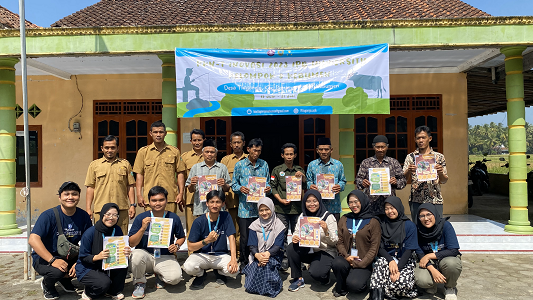
To overcome the problem surrounding the golden snail and rice ear bug pests that are attacking and damaging rice plants in Tlogorejo Village, Bonorowo District, Kebumen, Central Java, the Thematic Community Service Program (KKN-T) Innovation students from IPB University conducted counselling on the control of these two pests. The counselling took place only a short time ago at the Tlogorejo Village Hall, which was attended by the Ayem Farmer Group as well as the Selamet Farmer Group.
"Golden snail is classified as an important pest in rice plants. The attack of golden snails mostly occurs during the rice seedling stage or vegetative phase, while the adult females lay their eggs during the generative phase. Golden snails are noted to require an approximate of 2 to 2.5 months in one life cycle and additionally are able to reach the age of about 3 years," explained Nurbaiti Santika, a student from the Plant Protection Study Program at IPB University during the counselling session.
The demonstration on controlling golden snail pests was done by Nurbaiti Santika. She did this by making use of papaya fruit. The stem or leaves of the papaya are placed on a net to ensnare the snails. In practice, the net is placed at the edges or in stagnant water, which will allow the golden snails to gather and feed on the bait.
In addition to the golden snail, Nurbaiti continued, the rice ear bug is also named a potential pest that can become a significant threat, causing yield losses of up to 50 percent during certain periods. This is because the rice ear bug causes significant discoloration of rice grains.
"Controlling the rice ear bug is done by creating traps using skewered golden snails resembling satay, which are then placed inside mineral water bottles. The bottom of the bottle is filled with a soap solution to kill the rice ear bug," she explained further.
Nurbaiti made clear that these traps should ideally be placed on the edges of the paddy fields. This is useful for trapping the pests with the strong aroma emitted by the golden snails.
"The tools used to create the traps are quite simple, making it accessible for farmers to replicate. Our hope is that the farmers can observe, see, and implement what they have learned from the counselling provided by the KKN-T Innovation students," said Munawir, representing the village officials of Tlogorejo.
"The practices used to control the rice ear bug are deemed straightforward and simple enough, which enables farmers to apply them in addressing the pest issue," added Sugeng Priyono, Chairman of Selamet Farmer Group in Tlogorejo Village.
The team members of the KKN-T Innovation program from IPB University in Tlogorejo Village include Fadrian Difa Athallah (Aquaculture), Faiz Poetra Rianto (Utilization of Fisheries Resources/PSP), Elena Cendania (PSP), Ninda Riska Amiati (Aquatic Product Technology/THP), Syifa Nuzullia Salsabiil (THP), Najah Mahmudi Rangkuti (Fishery Resource Management/MSP), Muhammad Ramdan (MSP), Nurbaiti Santika Prima (Plant Protection), Hiqfitru Ahmady Putra (Marine Science and Technology), and Sintesa Windi Rahmawati (Livestock Production Technology), with Field Supervisor Fajar Maulana, SPi, MSi. (*/Rz) (IAAS/ZRT)

