IPB Student Conducts a Research on Nanosilica from Kettle Ash to Overcome Water Pollution
Bagasse is the waste of sugar industry in Indonesia which can lead to environmental pollution, especially in river water, if it is not handled properly. Efforts to minimize sugarcane waste are usually done by utilizing bagasse as boiler fuel. However, this kind of utilization still leaves waste from the combustion process, called as kettle ash. As much as 900 tons of kettle ash from the weight of processed cane would be produced if the entire industry in Indonesia utilized bagasse as boiler fuel in 2014.
Currently the utilization of kettle ash is still limited to the basic ingredients of organic fertilizer, cement replacement in the manufacture of brick, and ceramic making materials. Some researchers said that the silica content as the organic material in ash of the kettle is about 70%.
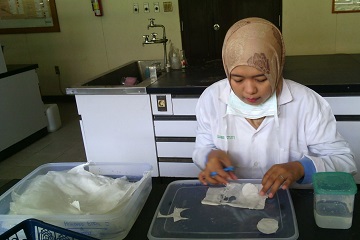
Therefore, Elsa Windiastuti, a student of Agricultural Industrial Technology Study Program, Graduate School of Bogor Agricultural University (IPB), utilized silica to become the additive material of polysulfone making. Polysulfone membranes are commonly used as water and wastewater treatment media.
The idea that uniform and homogeneous particle size on a very small scale (nano) is excellent in the field of both science and industrial applications leads this Lampung-born woman to make nanosilica membrane made of kettle ash with some mass variations under the guidance of Prof. Suprihatin, Prof. Dr Nastiti Siswi Indrasti and Prof. Udin Hasanuddin.
"The results of the study showed that the addition of nanosilica was able to decrease the contamination of the samples, to reject the colour and turbidity of the water, to decrease the content of water impurities until it reached the quality of raw drinking water, and to reject the water microorganisms. In addition, filtering with this membrane was also able to improve water quality," said Elsa.
Elsa hopes this research can be applied in the sugar industry for the processing of wastewater generated from the industry.
"So, the sugar industry will be sustainable and zero waste because the wastewater can be utilized again. The wastewater can also be utilized by people or areas where the river water is polluted," Elsa added. (TK).