Researchers of IPB: No Stopping Signs for the Development of Jabodetabek
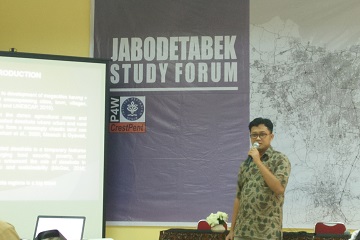
Research Center and Planning for Regional Development (P4W), of the Institute for Research and Community Service, of Bogor Agricultural University (P4W LPPM IPB) organized the “Jabodetabek Study Forum Discussion Series", on Monday, 9 April 2018, at Ahmad Baehaqie Hall, P4W LPPM IPB, IPB Campus, Baranangsiang, Bogor.
The “Jabodetabek Study Forum Discussion Series” was the second discussion organized by P4W LPPM IPB, the first discussion was implemented on 29 January 2018. The present discussion took two subjects, namely "Modeling Developers' Economic Behaviour Using Agent-Based Modeling Approach with The Case Study of Urban Growth of Jakarta Metropolitan Area, Indonesia", and "Urban Agriculture as an Alternative Policy for the Management of Desakota Regions."
"Similar type to the present discussion, the Last January Program, was about the impact of urbanization and urban development in Jabodetabek area to increase environmental degradation," said Dr.Ernan.
The second forum of Jabodetabek Discussion was directed to urban growth modeling in Jabodetabek. This special area was chosen as a discussion because urban growth is still continuing today.
Director of P4W LPPM IPB, Dr. Ernan Rustiadi, said with regard to the Jabodetabek discussion, the Jabodetabek growth tends to be underestimated. Unlike the megacity in large countries that tend to slow down, no stopping signs for the development of this Jabodetabek. Well this is a remarkable phenomenon that needs to be discussed.
The modeling approach used is Automata Cellular approach (Cellular Automata Approach). A cellular automaton (pl. cellular automata, abbrev. CA) is a discrete model studied in computer science, mathematics, physics, complexity science, theoretical biology and microstructure modeling. Cellular automata are also called cellular spaces, tessellation automata, homogeneous structures, cellular structures, tessellation structures, and iterative arrays. This mobile automata model uses four main components consisting of space, set of states, neighbourhood, and transition rules. The concept of this Cellular Automata model is adapted to slope, land use, area not included in analysis, and existing urban area. The results of this adapted model are expected to replicate the complexity of the existing settlement form.
A cellular automaton model is utilized to explore the impacts of coastal flood risk management strategies on the urbanization parameters. This cellular automata approach can be used to model the economic behavior of a developer. Cellular automata are computational frameworks that model in discrete time bottom-up interactions between elementary spatial entities (cells). They can both generate forms consistent with known urban processes and optimize those forms by simulating how different development strategies result in actual urbanization patterns. In addition to modeling developer economic behaviour, this mobile automata model can also be used by governments to consider projects proposed by developers.
The Jabodetabek discussion also discussed the problems of urban agriculture in Jabodetabek. Issues discussed include urban farming, agricultural markets, urban agriculture governance, and urban food security.
Potentially, this urban agriculture can be improved and developed to increase the economy condition of farmers in urban areas. As agricultural products are more marketable and quickly channelized to consumers. (Wied)