Researchers of IPB Assessed the Influence of Modernization toward the Local Wisdom of Bajo Tribe
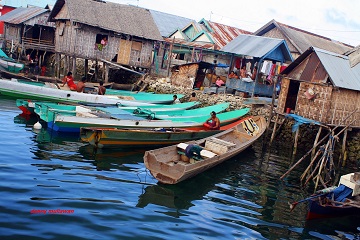
Most coastal communities in Indonesia had a pattern of life called the coastal culture. The efforts for the exploitation of the marine resources conducted by the coastal communities (fishermen) were faced with a harsh environment and overwhelmed by a sense of the uncertainty. So to face the environmental uncertainty required the knowledge, the beliefs, the understanding, and custom to act appropriately and strategically often known as the local wisdom.
The research conducted by Dr. Mutiara Fadhila and Dr. Soeryo Adiwibowo about the influence of the modernization on the local wisdom of Bajo Tribe in the utilization of the marine biological resources. They came from Department of Communication Science and Community Development, Faculty of Human Ecology, Bogor Agricultural University (FMIPA-IPB).
Dr.Soeryo said that the modernization was a process of transformation where there was a change of community in all aspects. The modernization through the enhancement and use of fishing gear and capital assistance resulted in the changes in a community. The propulsion program of the Blue Revolution, instead of creating more advanced fisheries and fishermen, became prosperous, but created the complexity of the fishery problems. This was a concern, because not all layers of fishermen could take advantage of the modernization opportunies and only a small percentage of fishermen who could enjoy it.
Dr. Soeryo explained, Bajo tribe was the noble sea nomads scattered in various regions of Indonesian waters. Bajo tribe had a set of local wisdom in the management of the sea, because of its very close relationship with making the sea as a sacred place and owned by the ancestors compared with other tribes such as Bugis-Makassar which were able to organize their lives in all places.
“In terms of the livelihood efforts, there has been a shift from the social orientation to the economic orientation. The results of the relocation of Bajo residents led to a shift in the use of the technology in utilizing the marine biological resources,” he said.
The result of the study of the researchers of IPB showed that the modernization of the capture technology had changed the catch fleet, the range of territory and number of fishing trips, as well as the value of the catch. This modernization was mostly adopted the fishermen under 50 years old.
As a result, the local wisdom of Bajo Sapeken Fishermen in reading the natural conditions faded and only owned old fishermen. However, the confidence in fishing activities was still embraced by Bajo Sapeken Fishermen. Second, there was a shift in the orientation of the cultural values in terms of the human relationships with the nature, from living in harmony with the nature to lean towards conquering the nature.(AT/ris)