Team of IPB Researchers Predicted the Drought Risk in Indramayu District
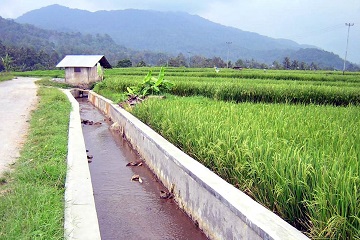
Indramayu Regency is a strategic region connecting Bandung and Jakarta. According to Indramayu’s topography, the region is really prone to several types of disaster such as tornado and flood. High rain intensity lets water runoff exceed the capacity of drainage system. It is one of the rice barn of West Java Province and also for national level. Indramayu district is located in lowlands which occurred from deposition of river sediment as it drained into the sea. a lowland area so that water supply for agriculture is much supplied from upstream areas. These areas are normally a flat plain with fertile soils, and the climate is quite dry. The rainfall is quite variable, with a precipitation of 2,571 mm in 2014 but half that in 2012 and 745 mm in 2016, partly due to the climate phenomena El Nino and La Nina. Therefore the Region needs urgent assistance as way to mitigate the drought situation that has crippled the Region (efforts to reduce disaster risk). The study of drought disasters in this region must be comprehensive, not only to examine the administrative area, but also to see the condition of the upstream area.
The first year of research project was implemented by a group of researchers from the Department of Soil Science and Land Resources, Faculty of Agriculture of Bogor Agricultural University (FAPERTA IPB), namely Boedi Tjahjono, Baba Barus, and Yayat Hidayat. The group focused their research project on watershed (CAS) of Cimanuk Hulu as upstream Regency of Indramayu. The first year project aimed to map out land cover / land use (1995, 2005, 2015) and facade of Cimanuk watershed; Analyzing land use change, predicting land change in 2025, and analyzing the closure / land use relationship with land facet; as well as conducting critical land analysis and mapping.
The method used in this study is the visual interpretation of the image both for mapping closure / land use or land facet. Overlapping techniques will be used to extract attribute data for analysis of land cover / land use changes and land cover / land use with facet land. Whereas for the prediction of land cover / use in 2025, the group used Markov Chain method. Meanwhile, the method of analysis for critical land mapping is from the Perdirjen BPDAS PS Number P. 4 / V-Set / 2013 which is modified through weighting and scoring.
The present research revealed that in 1995, 2005 and 2015 respectively rice fields (42,275 hectares), mooring (43,356 hectares), and mooring (50,702 hectares) were the agricultural land uses that dominate plains and low hills of the Cimanuk Hulu Basin. During the period 1995-2015, extensive reductions occurred in forest cover / land use, rice fields, grasslands, and plantations. However, other areas experienced increased in its land uses for mixed garden, open land, settlement, and moor. River water bodies were not changed.
It is projected that on 2025, there won’t be much change for the land uses only the water body will be expanded by 35 hectares and the mixed garden will decrease by 311 hectares. In relation to land facets, rice fields and settlements areas will dominate the fluvio-volcanic plains, forest will be expanded into the facade of vulcanic mountain ranges, water bodies and mixed gardens will be expanded into the river basins, grasslands and open land will be established on the facade of cone complex Guntur volcanic, plantations will planned on the lower slopes of a denudational volcanic cone, and the irrigated moor land will be expanded and relatively will diffuse across land facets to the central slopes of a denudational volcanic cone.
Whereas the last land facet stated above ecologically should be well covered by high density vegetation (forests, plantations). This condition will lead to decreased rainwater absorption into the soil and increased surface flow volume. For example, the low density of vegetation cover as appeared by moor lands, as well as the basal morphology of Garut City and surrounding areas can be and be suspected as the cause of flash flood disaster in Garut regency on 20 September 2016. (Wied)