IPB Researchers Successfully Produced Corn Noodles Similar Quality as Wheat Noodles
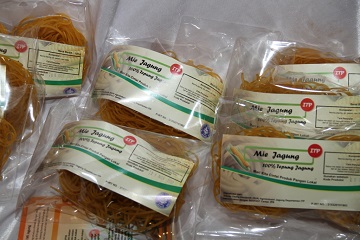
Noodles are long thin piece of food made from a mixture of flour, water and eggs usually cooked in soup or boiling water. An instant noodle is a food item made from unleavened dough that is made from different types of ingredients. Instant noodles are an important product for the Indonesian consumer. Why do Indonesians from all income levels like to eat instant noodles? Simply, because it is delicious, quick and easy to prepare, and widely available in the modern and traditional retail markets across the Indonesian archipelago. It's made primarily from flour, means it contain mainly carbohydrate, and you still need protein and fat and vitamin and minerals in your diet. One alternative substitution of wheat flour especially in the manufacture of noodles is by utilization of maize. Maize is one of the commodities that has adequate nutritional value and in some areas in Indonesia has been used as staple food. In eastern Indonesia, people have traditionally consumed corn, cassava or sago as their daily staple food.
Ir. Subarna and Tjahja Muhandri from the Department of Food Science and Technology, of the Faculty of Agricultural Technology of Bogor Agricultural University (FATETA IPB) implemented the research program on the process of producing noodles made from corn flour with calendering technology.
Subarna stated that in the effort of food diversification, noodles can be categorized as one of food commodity substitution because it can serve as staple food. Based on the study of consumer preference for non-rice food products, noodles is the most frequently consumed food product for most consumers. This can be used as a reference by increasing the added value of corn as a raw material for making noodles.
Corn is one of the food alternatives to replace rice in Indonesia. It can be seen in the Madura and West Nusa Tenggara, Indonesia. Therefore, the use of corn flour as raw material for making instant noodles can likely be accepted by many people of Indonesia. "Corn noodle has several advantages over other food products. Corn noodle contains 36 calories or its nutritional value is higher than rice (178 calories), cassava (146 calories) and sweet potato (178 calories). In addition, the yellow corn contains is β-carotene, lutein and zeaxanthin, "he explained.
He said, that the corn noodle has its own advantages compared to other noodles such as having a natural yellow color produced by β-carotene, lutein, and zeaxanthin. In addition, the corn noodles also have a greater nutritional value than rice, cassava and sweet potato i.e., about 360g kalori/100 material “unpublished”. While the yellow color in the wheat flour using tetrazine food coloring materials. Another advantage of corn noodle is the raw material can be grown in Indonesia, so it can reduce the dependence of wheat imports.
According to Subarna, the characteristics of corn flour or corn starch with different wheat, especially on the quality of protein gluten owned by each material. Wheat gluten has elastic properties so that the dough and noodle ropes are not easily broken during processing. Whereas corn flour does not have enough gluten to form elastic dough. Thus, the corn flour instant noodles are easily broken, fragile and low intactness. This results from high zein content which could amount to 60% in the corn. While the amount of corn gluten is relatively small and the proportion of quality is less favourable. The high zein content makes noodles difficult to be shaped and molded because zein can shape the dough elastic-cohesive mass. Therefore, the process of making corn noodles must be adapted to the characteristics it has.
He also added that the cornmeal production process is 100 percent through steam stages, material mixing, dough rolling, sheet formation, noodle formation, noodle cutting and noodle steaming. The results obtained are noodles with rheological characteristics (elongation, elasticity, hardness) and cooking loss (cooking loss) that resembles flour noodles. Instant noodles produced by applying corn flour 45% and tapioca 55% had met the quality of the Indonesian standard for instant noodles, except the protein content of 2.81% (minimal 4% according to the quality standard). (Wied)