Predict Rice Fields in Karawang will be Expired in 2064, IPB Students Hold First Place
After the data is modeled, predictions are made and finally it can be concluded in the next five years, the rice field area in Karawang continues to decline. “If it is assumed that the rate of decline is constant, then the rice fields in Karawang will run out in 2064,” said Devy Apriansyah, a student of Computer Science, Faculty of Mathematics and Natural Sciences, Bogor Agricultural University (FMIPA IPB) class of 2015.
This conclusion was obtained after Devy and his two friends, Octavian Wibawa Reksa (Computer Science 2015) and Dian Ayuningtyas (Statistics 2015) when collecting data on the existence of rice fields in Karawang during the period 2003-2018. The data they obtained from the United States Geological Survey (USGS). Then the data is processed using GIS (Geographic Information System) satellite imagery.
Karawang is a district located in West Java. Directly adjacent to Bogor Regency, Subang, Cianjur, Purwakarta and Bekasi. Karawang was once known as its granary in West Java. The majority of the people of Karawang work as farmers and there is a vast area of rice fields around 97 hectares. However, the paddy fields are shrinking.
“We chose the Karawang area because we wanted to expose the Karawang area where the land began to function as industrial land and also to help the government in taking policies,” said Octavian as the team leader.
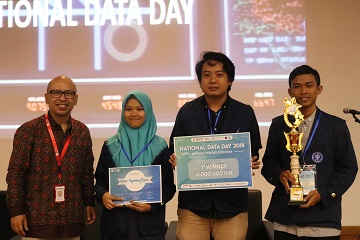
They included the results of the analysis in the National Data Day competition organized by the Student Association of Telecommunications and Information Business Management, Faculty of Economics and Business, Telkom University, Bandung. The highlight of the competition was held on 19 November 2018 ago. They named their team as Data Farmers.
In the competition Data Farmers Team can set aside the host and other finalists. So that they can bring home the title of First Winner. According to Devy, choosing the right race partner is a good start to realize the competition idea.
“The hope is that the data we process can support the government in taking policies,” Octavian concluded. (FM)