
Utilizing the Potential of Quail, IPB Students Became a Champion of Event of Young Researcher and Economics Student
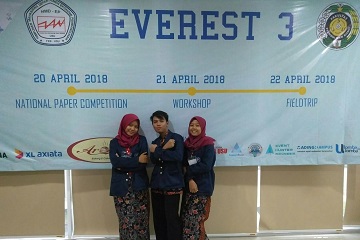
Utilizing the potential of quail, three Bogor Agricultural University (IPB) students successfully won the second champion in the 2018 Event of Young Researcher and Economics Student (EVEREST) ??at Universitas Sumatera Utara (20-22 / 4). They are Hafzil Adli, Eva Kurniasih, and Tanti Setiowati.
Data obtained from Indonesian Quail Farmers Association, 2014 to 2017 shows that Indonesia is still short in fulfilling quail egg demand. Demand is much greater than the current rate of production. Community empowerment needed to raise a quail so that demand can be fulfilled. That's the background behind the creation of ideas to raise the potential of quail.
"In 2017 the number of quail egg demand in Indonesia was 728 million while supply of quail eggs from our farmers only amounted to 212.4 million. In our opinion, this quail demand must be fulfilled by local farmers. So we designed the business system together with the implementation of integrated agriculture based on quail entrepreneurship," said Hafzil Adli, student of Agribusiness Department, Faculty of Economics and Management (FEM) IPB.
According to him, there’s also a potential in the quail, not only on the eggs alone. Meat until feces also has a very good potential if developed. Quail meat has lower cholesterol levels than chicken and duck meat. Feces can also be used as fertilizer or catfish feed.
Integrated farming system that he developed focused more on catfish feed. Quail feces that rich in protein for catfish can shorten the harvest period of catfish.
"Quail feces has a high protein to feed catfish. Moreover, quail feces as catfish feed can shorten the harvest time which usually done in three months to just one month. Minimization of cost has been applied, efficiency of time and resources has also been very good," said Eva Kurniasih.
Furthermore, Eva explained that quail feces is not only used for feeding but also for hydroponic farming. First, the feces is fermented and then added with other elements.
"If only the feces of quail, it will not be sufficient enough as substances needed by plants. So what we use here is hydroponic substrate. So there is a small pipe as a channel and this hydroponics is not using water, but using charcoal husk. Later, the fermented feces will later go in there," said Eva.
The joint venture system designed by three IPB agribusiness students is a joint business system with the principle of ruhiyah rupiah or social capital. Ruhiyah rupiah concept is a group of pengajian (circle that focused on reviewing religion study) or arisan (circle of acquaintance that have a periodic gathering) that already have trust and openness among each member so they can form a joint business.
"The concept of ruhiyah rupiah here is a group pengajian or arisan form a joint business. Management and capital will be set according to initial agreement based on trust. Values ??in their social capital are the key to build the business relationships so that opportunistic behavior of group members can be reduced and participatory attitudes can increase," said Hafzil, a student who once won a national high school business plan competition.

