
Halal Science Center IPB University Provides Training on the Handling and Slaughtering of Sacrificial Animals in 2023 for DKM Management
Eid al-Adha is just a few days away. Qurbani preparations are also getting closer. However, there are still qurbani practices that do not fulfill the Sharia requirements.
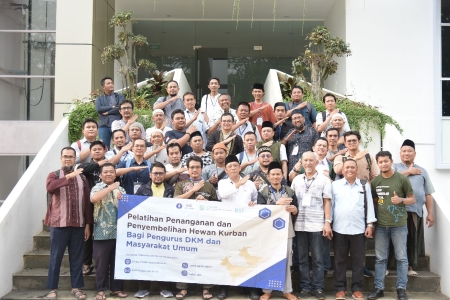
To ensure the smoothness of Qurbani worship and improve the competence of the community, Halal Science Center (HSC) IPB University held a training on Handling and Slaughtering of Sacrificial Animals in 2023 for the Management of the Mosque Prosperity Council (DKM) and the General Public in a hybrid manner at the Vocational School of IPB University, Saturday (24/6).
In collaboration with the Professional Certification Institute of the Indonesian Ulema Council (LSP MUI) and Bank Syariah Indonesia, this training presented experts in sacrificial animal management from IPB University, namely Dr drh Supratikno from the School of Veterinary Medicine and Biomedical Sciences and M Baihaqi SPt, Msc from the Faculty of Animal Science. Also present was the President Director of LSP MUI, Drs H Aminudin Yakub MA.
"HSC IPB University as a multidisciplinary institution seeks to improve the competence of the community in handling sacrificial animals according to sharia to produce halal and tayyib meat," said the Head of HSC IPB University, Prof Khaswar Syamsu in his speech.
Drs H Aminudin explained the sharia and fiqh related to the implementation of sacrificial worship. He explained that the implementation of Qurbani should begin with the selection of sacrificial animals that meet the requirements, namely age and health.
"The equipment must also be considered, both sharpness and cleanliness to ensure that the sacrificial animals die from the correct slaughtering technique," he explained. According to him, the correct slaughter technique can prevent the death of animals due to doubtful things.
Regarding the technicalities of slaughtering sacrificial animals, Dr Supratikno explained that both slaughter officers and people who help with the slaughtering process must be able to pay attention and prepare the best environment and facilities for animals.
"The three main keys in slaughtering are the environment and design of the slaughterhouse, the competence of the officers, and the appropriate equipment. The five principles of animal welfare must also be implemented," he said.
Furthermore, he also provided tips and techniques for making knots in the method of laying down sacrificial animals properly. Participants were also given the material on how to slaughter sacrificial animals according to Sharia through video demonstrations.
The last speaker, M Baihaqi, explained tips on selecting and estimating sacrificial animal meat and post-slaughter handling. The public can estimate the carcass weight of sacrificial animals by visual inspection.
"Simply put, the percentage of meat or carcasses can be estimated by looking at the perototan and thigh distance of the animal. However, the weight of the carcass still depends on the size of the skeleton, sex, age, and condition of the animal," he explained.
He emphasized that the handling of carcasses after slaughtering must be hygienic. He highlighted several cases where Qurbani caretakers sometimes forget that carcasses should not be slaughtered on the floor and near the feet.
"Carcasses should be handled as soon as possible to prevent them from spoiling and becoming a source of disease. The place where the carcass is handled must also be hygienic and always cleaned," explained Baihaqi (MW/Rz) (IAAS/TNY)

