Challenges of Livestock Processing Industry in Industrial Era 4.0
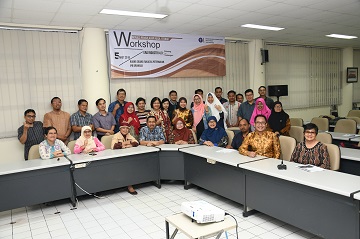
The livestock industry as a producer of processed food products is growing. “In the industrial era 4.0 or disruption industry, where animal products are created and everything is made faster, smarter, and more efficiently. “The industry in the disruption era is related to all-digital technology that is connected to the internet,” said the Lecturer of the Department of Food Science and Technology (ITP), Faculty of Agricultural Technology, Bogor Agricultural University (Fateta IPB), Prof. Purwiyatno Hariyadi at the Workshop on Innovation in Processing Livestock Products in the Industrial Age 4.0, Tuesday (5/3) at the Dramaga Bogor IPB Campus. This workshop was held by the Department of Animal Husbandry Production and Technology T (IPTP), Faculty of Animal Husbandry (Fapet) IPB University.
Furthermore, Prof. Purwiyatno explained that humans will always depend on food availability in this case meat. Demand for meat and poultry continues to increase with the exponential growth of the world’s population. Therefore, the meat and poultry supply industry must continue to innovate to produce large quantities of food in a fast time in the era of industrial revolution 4.0.
“Technology will always develop to support various aspects of human life, including in the field of animal husbandry. Disruption can basically be said as a form of innovation in various aspects, not only related to information technology (information technology), so that it can occur in the concept of business or any kind of things. “The disruption era is considered to change life for the better,” said the researcher of the South East Asia Food IPB Agricultural Science and Technology (SEAFAST).
Prof. Purwiyatno added, the disruption era was marked by millennial generations who continued to show their teeth with work, competing to present technology aimed at increasing productivity and business efficiency in the field of animal husbandry. Some start-ups in the livestock sector provide a new perspective, both for the livestock industry and for farmers.
Prof. Purwiyatno said that in the era of 4.0 industrial revolution for farmers, especially smallholder farmers, should be a concern. There are several obligations of community farmers to survive in the era of digital business. First, information and technology infrastructure in the form of internet networks. Second, clustering of regions according to specialization in livestock such as cattle and poultry, for the distribution of breeding, fattening, cutting, or producing milk. Third, the use of financial technology as innovation in access to capital. Finally, business networking through the application system. “Efficiency can be achieved in transportation, logistics, communication and production through networking,” said Prof. Purwiyatno.
Prof. Purwiyatno appealed for graduates or students that the era of industrial revolution 4.0 is both an opportunity and a challenge to be looked at well. The human role is gradually taken over by automatic machines. As a result, the number of unemployed is increasing. Therefore, to take advantage of opportunities and answer the challenges of the industrial revolution 4.0, university graduates in Indonesia are required to have data, technology and information literacy skills. Data literacy is needed to improve skills in processing and analyzing big data for the benefit of improving public and business services. Technology literacy shows the ability to utilize digital technology to process data and information. Whereas human literacy must be mastered because it shows soft skill elements or individual character development to be able to collaborate, be adaptive and be wise in the “flood” era of information.
While other speakers were Director of CV Fiva Food, Ir. Betsy Monoarta conveyed, the application of industry 4.0 in processing livestock products was able to encourage the innovation process and increase productivity, accelerate the product process and packaging well, the products produced were more specific in scale and better so as to encourage the creation of reliable factories. ”
While the Deputy Dean of Academic and Student Affairs at Fapet IPB University, Prof. Sumiati said, in the industrial era 4.0 the existence of livestock technology was very important. Where currently population growth is increasing and many consume processed products from livestock and poultry. While millennials demand everything practical and instant in the pattern of serving food or fast in consuming processed products from meat. “This is an opportunity for the field of livestock products to be able to meet the demands of consumers and the challenges to provide the best for consumers in the supply, especially in this industrial era 4.0, every processed livestock product can be served quickly, practically and economically,” said Prof. Sumiati. (NR)