Professor of IPB: Indonesian Economy is controlled by the Private Sector
Prof. Didin Damanhuri, Professor of the Faculty of Economics and Management (FEM), IPB University, said that currently the economic gap in Indonesia is very high because the economy is dominated by a handful of people. Indonesia is known for the most lame of the rich people’s growth. According to the Chairman of the Nusantara Economic Study Circle (KEIN), the economy in Indonesia is now controlled by the private sector, with minimal involvement of the state in it. Thus, the economy is controlled by a handful of people.
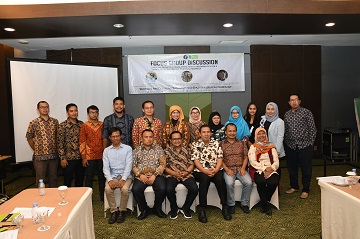
This was conveyed by Prof. Didin during his talk in the Focus Group Discussion (FGD) held by FEM of IPB in collaboration with KEIN at IPB International Convention Center (IICC), Bogor, (16/2). According to him, currently agricultural economic development still tends to be based on large corporations, such as food estate, horticultural estate, development of maritime infrastructure like sea tolls, and other infrastructure development in the border area.
“The majority of development has not been in the framework of ‘people driven’, but it still tends to be ‘corporate driven’. If this continues, a repetition will occur, namely high economic growth without solving the problem of inequality. This is compounded by the current system which is not very conducive to the economy. All are busy with political conflicts, and social media increasingly replaces the role of the state,” he said.
In this activity, Prof. Didin offered to return to the Pancasila Economic System, where the economic system is based on kinship and mutual cooperation. This system has been echoed for a long time, and it is even stated in Article 33 of the 1945 Constitution.
“This article states that the economy is structured as a joint effort based on the principle of kinship. However, today this kind of economic system is unpopular,” he added.
Meanwhile, the Dean of FEM of IPB, Dr. Nunung Nuryartono said that through this event it was hoped that big thoughts would be born for Indonesia’s economic development. With the existing constitution, IPB wants to highlight how the work of Pancasila economy and its implementation are, especially in the cooperatives and rural development.
“We all know that so far the cooperatives are constitutionally in law but their development have not developed as expected. Whereas, it is a place of economic activity that can generate economic development. Not only that, rural development is also very important because poverty occurs in many rural areas. Therefore, the synergy of these two things is important. The Pancasila economic conception and the cooperative as its vehicle encourage poverty alleviation, especially in rural areas,” he said.
The target is that IPB wants to create a Pancasila economic center soon. Therefore, FEM of IPB will routinely hold FGDs to accommodate thoughts. In addition, FEM will also conduct comparative study to several universities. According to him, KEIN and the Ministry of Economy provided this facilitation where IPB was asked to become the activator.
“We already have a network of universities that are concerned about these thoughts. FEM was asked to become the leader to encourage research related to Pancasila economics. In the near future, FEM will hold a national symposium and call for paper to find out how far students think about the Pancasila economy. Although this is not popular, we must keep moving forward because the Pancasila economy is considered to be effective in advancing Indonesia’s development. These discussions are expected to become a book which contains the next five-year development recommendations that is beneficial for the government,” said Dr. Nunung.
Besides Prof. Didin, the FGD also presented Luwarso as cooperative activist, Suroto as Chair of the Strategic Socio-Economic Cadre Association (AKSES) and Chair of the Trisakti Bhakti Pertiwi Cooperative (KOSAKTI). (dh/zul/ZSP)